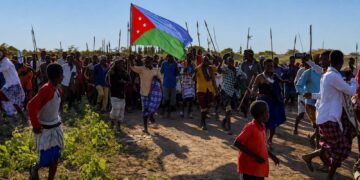


MOGADISHU, SOMALIA – Somalia’s electoral commission published Galmudug’s local council results on Monday. President Hassan Sheikh Mohamud’s Justice and Solidarity Party swept the field. The Galmudug election results give the ruling party 135,247 of the 193,451 valid votes and 63 of the 189 contested seats. Few people in Mogadishu or Dhusamareb treated the outcome as news. The campaign had one approved script, and the count followed it to the last line.

What the Galmudug election results say
The National Independent Electoral and Boundaries Commission released the figures on Monday evening. The ruling JSP took just under 70 percent of the valid vote. The Towfiiq organisation placed a distant second with 26,003 votes and 12 seats. Sincad won six seats on 12,862 votes, and Karaamo took five seats with 10,668. No other grouping came close, and the commission said the vote followed the law.
The arithmetic behind those totals deserves a closer look. The commission had enrolled 215,860 voters across Galgaduud and Mudug before polling day. It then counted 193,451 valid ballots. So almost nine in ten registered voters turned out, and nearly every one of them cast a clean ballot. That figure would rank among the highest turnout rates on earth. It came from a state where al-Shabaab holds rural districts, where police locked down every large town, and where some voters carried paper slips instead of cards.
Opposition politicians questioned the transparency of the process. Several parties said the contest never offered a level field. The federal government and the commission rejected those complaints and called the vote lawful. Both reactions were as predictable as the Galmudug election results themselves. Federal ministers had joined the campaign openly, so a clean bill from the commission was never going to convince the other side.
Consequently, the headline number matters less than the direction it confirms. Villa Somalia wanted a loyal council map in Galmudug before the state picks its next president. It now has one, and it got there without a single competitive moment.
A sweep arranged before polling day
The outcome was settled in June, long before any ballot was printed. Galmudug president Ahmed Abdi Kariye, known as Qoorqoor, quit the race on 25 June after talks with federal officials. His exit removed the only incumbent obstacle. Hassan Sheikh then named Liban Ahmed Hassan, widely called Liban Shuluq, as the sole JSP standard-bearer. No internal party contest took place. From that point the vote was a procession, not a race.
Federal ministers turned the campaign into government business. Environment Minister Bashir Mohamed Jama toured Dhusamareb, Galkayo, Bitaale and Sangaduud with lawmakers in tow. He urged crowds to vote, announced no projects and pledged no money. A deputy minister worked the same circuit. The state’s own authorities had earlier called federal party offices in the districts illegal. JSP opened a Dhusamareb headquarters anyway and campaigned from it.
The mechanics of polling day told the same story. The commission moved the date twice, from 20 July to 25 July and then to 30 July. Galmudug police announced a general curfew across every large town for the vote itself. Officials framed the lockdown as protection for voters. Critics saw a ballot held under a movement ban, run by the same authorities whose party stood to win.
So the Galmudug election results read as the closing entry in a managed sequence, not a snapshot of public opinion. Every stage, from candidate selection to curfew, ran through offices aligned with Villa Somalia. A win produced that way carries weight in seat counts. It carries far less as evidence of consent.
What 63 seats buy Villa Somalia
This was the second local ballot held under one person, one vote in a federal member state; South West State went first. Federal officials present the Galmudug election results as the long-promised break with clan-based indirect selection. Yet the sequencing serves a narrower purpose. Hassan Sheikh’s own term expired on 15 May, and parliament’s mandate lapsed on 14 April. He needs friendly state leaders to outnumber his critics when federal talks resume.
Analysts now tip Liban Shuluq as the front-runner for the Galmudug presidency, though that vote has no date yet. A council map dominated by JSP makes his path short. Hirshabelle published its own electoral timetable on 26 July, with familiar complaints of federal meddling attached, and South West is already banked. Three loyal state presidents would hand Villa Somalia a working majority at any National Consultative Council session. Meanwhile, Puntland and Jubaland coordinate openly against the federal government from outside the room.
The double standard remains the tell. In March the Interior Ministry rejected the Baidoa vote that returned Abdiaziz Laftagareen in South West State, calling it a pre-planned self-appointment. Four months later, the same government cheers Galmudug election results built on one approved candidate, a curfew and a cabinet on the campaign trail. Direct voting earns federal praise when Villa Somalia’s man wins, and federal condemnation when he does not.
Supporters answer that 215,860 registered voters in an insecure region is a real feat. They add that elders picking delegates behind closed doors was worse. That defence has force. It still leaves the central question open. A ballot with one serious name on it transfers power; it does not confer legitimacy.
The opposition contests the larger prize
While the count closed in Dhusamareb, the fight over national legitimacy sharpened in Mogadishu. Opposition lawmaker Abdirahman Abdishakur Warsame pushed back on Sunday against claims that his alliance wants a return to transitional rule. A letter the bloc sent to foreign partners proposed an interim body to oversee elections and manage the handover if no caretaker government forms. “Somalia’s crisis is political, and its solution must also be political,” he said.
Warsame’s constitutional case lands close to the Galmudug story. He noted that an expired government carries on only as a caretaker, and he accused this one of refusing that role. A caretaker government does not build party machines inside member states or run ministers through regional campaigns. The federal government has not answered his remarks. Its answer sits instead in the Galmudug election results it engineered and now cites as progress.
The opposition bloc had already put legitimacy on the agenda of Somalia’s foreign partners before the Kampala summit. Those partners have their own deadline in mind. Diplomatic sources say donors warned the presidency to reach a broad political deal before the end of August, with development support under review. Hassan Sheikh spent the Kampala summit stripping dialogue language out of the communique while asking the same leaders for troops and money.
Each new managed vote strengthens his negotiating hand and weakens his credibility at the same time. The partners pressing for an inclusive settlement can read results tables too. They know what 70 percent for one party in a curfew election means.
A managed ballot in an unquiet state
The security backdrop makes the celebration ring hollow. Al-Shabaab still holds ground across rural Galgaduud and Mudug, and it has recruited clan militias inside Galmudug before. On Sunday, a day before the results landed, the group retook the town of Teedaan in neighbouring Hiiraan after clashes that left dozens dead. The front line moved backward while the ballots were being tallied.
Galkayo adds a second pressure point. The city sits split between Galmudug and Puntland, and the federal build-up around it has kept relations with Garowe raw. A JSP-run council map on the southern side of that line will not calm anyone in Puntland. Garowe already treats federal election projects as tools of encroachment. Moreover, every soldier guarding a political timetable is one missing from the fight the state is losing.
So the Galmudug election results close one chapter and open a harder one. Expect the new councils to seat quickly and the state assembly process to follow. Expect Shuluq to take the presidency unless the plan changes. Villa Somalia will then present the outcome as proof that one person, one vote works, and Hirshabelle comes next on the calendar with the same script ready.
What the sweep cannot deliver is the thing Somalia needs most before the foreign drawdown bites. A federal deal needs Puntland, Jubaland and the opposition at the table. Each managed vote pushes them further away. The Galmudug election results hand Hassan Sheikh another signature for his column. They bring the country no closer to a settlement, and the group watching from the countryside knows it.