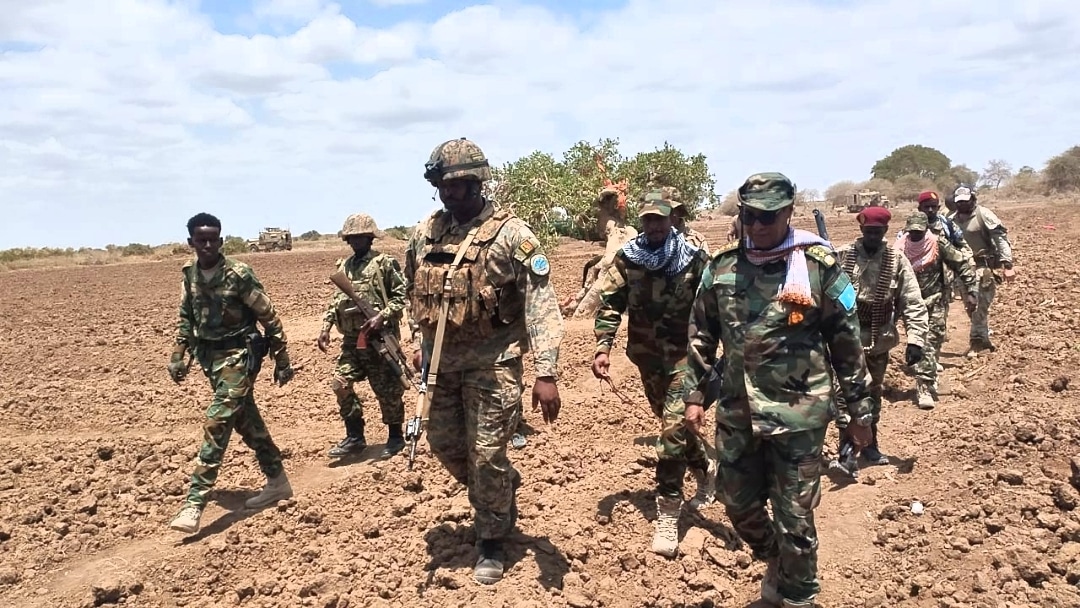
KAMPALA, UGANDA – The frankest public account of southern Somalia to emerge from the troop contributors summit came from a regional official who is now being called a traitor for it. Mohamed Abdi Ware, the deputy executive secretary of IGAD, spent the weekend accused across Somali social media of stabbing his own president in the back at the meeting in Uganda. On Monday he published the full text of what he actually said and invited people to read it and decide for themselves.

The document is not a polemic. Most of it is a long tribute to the Ugandan, Burundian, Djiboutian, Ethiopian and Kenyan soldiers who have held ground in Somalia for nearly two decades, written by a man who governed one of the regions they fought in. Only the last third turns to the present, and it does so in language that no Somali official used in public at the summit.
That is the reason the speech became a scandal. Ware described southern Somalia as it is rather than as the federal government prefers it described, and he did so in a room full of the governments whose soldiers are still standing in it. The offence was not that he attacked anyone. It was that he made the record honest.
What Ware put on the record
The rumours he was answering were specific. They held that his remarks at the ministerial session on 30 July had betrayed the Somali delegation and put the future of the African Union mission in jeopardy. Since Ware is Somali, a former president of HirShabelle and the second most senior official at IGAD, an accusation of that kind carries weight in Mogadishu in a way it would not if it landed on a foreigner.
His answer was to publish the speech in full along with the official summary transcribed by the meeting secretariat. He set out six sentiments behind it, and the first two are uncontroversial. He wanted to honour the African and Somali soldiers who died over the life of the mission. The second was an acknowledgement that the mission has now run for almost twenty years while al-Shabaab still holds large stretches of territory and the trade routes crossing them.
The third and fifth are where the trouble starts. Ware argued that the moment has arrived to assess the mission honestly, ask difficult questions and agree a way forward that locks in the gains and prevents a disorderly exit. He noted that the reckoning was forced on everyone by the unease of international partners rather than chosen by anyone in the region. He then wrote that the troop contributors and their taxpayers are entitled to ask why the mission has taken so long and what there is to show for it, and that hiding behind what he called faux sovereignty to avoid the answer simply will not work.
The sixth reads almost as a rebuke to the people accusing him. He wants Somali forces to take over security in the shortest possible time and the African contingents to go home as heroes, with their heads held high and the gratitude of the Somali people behind them. He then observed that he has no idea how such a sentiment could offend anyone, least of all a government that everyone in the room was trying to help.
Read as a whole, the speech is an argument for keeping the mission alive long enough to hand over properly. What made it dangerous is the description of the ground that argument rests on.
The map he was describing
Ware did not talk about southern Somalia in the abstract, because he does not have to. He served as president of HirShabelle, a state that runs from the outskirts of Mogadishu through the farming country along the Shabelle River and out towards the Ethiopian border, and he hosted Djiboutian, Burundian and Ethiopian troops there alongside African Union police units from several other countries. He worked with the Ugandan contingent in the neighbouring sector covering Mogadishu and Lower Shabelle.
His tribute doubles as a map of who has been carrying southern Somalia. Ugandan troops cleared Mogadishu street by street and drainage ditch by drainage ditch until the group could no longer hold the city. Burundian troops led the offensive at Wanlaweyn and Leego that opened the road to Baidoa. A Djiboutian push into Beled Weyne and Bulo Burte, both then isolated and hard to reach from the capital, was what allowed the federal government to extend any authority at all into the central regions.
Further into southern Somalia the picture is the same story with different flags. Kenyan troops in Jubaland and Ethiopian troops in the South West towns are the reason, in his account, that Kismayo and Baidoa are two of the most functional cities in the country. The Ethiopian presence in Baidoa also created enough space for aid agencies to reach the more than a million displaced people living in and around it.
Then comes the sentence the summit was not designed to hear. That hard won achievement, Ware wrote, is now under review. Al-Shabaab still controls vast rural areas that are essential to food production, and it still controls the roads that people and goods have to move along. From an IGAD vantage point it also controls much of the border country, which blocks the regional trade integration the organisation exists to promote.
He added a warning that goes wider than Somalia. The group retains formidable revenue generating capacity, he argued, and is developing links with Boko Haram and other West African and Sahelian networks, with the apparent aim of forming a corridor running from West Africa to the Indian Ocean. That is his assessment rather than an established fact. It is also the assessment of the deputy head of the region’s own intergovernmental body, delivered to the governments that would have to live with it.
A year of losses in the same sectors
Everything Ware said about the ground is consistent with what has happened in those sectors over the past eighteen months. The reversal did not begin in the north or in the contested politics of Puntland and Jubaland. It began in southern Somalia, in exactly the areas the African Union contingents were sent to hold, and it has continued through a period when Mogadishu insisted the campaign was going well.
Aadan Yabaal fell in April 2025 and Moqokori in June, and by that summer the group had retaken more than twenty settlements across Hiiraan, Lower Shabelle and Middle Shabelle since February alone. In July 2025 it took Mahas, its first capture of a Somali town in more than a decade, a place that had been in government hands since 2014 and that controls the junction linking Hiiraan to Galgaduud and Middle Shabelle. It has held the town for a year without a serious attempt to retake it.
The mission itself has taken casualties in the same period. A vehicle bomb struck a Ugandan convoy in Lower Shabelle in July 2025 and killed around twenty soldiers, and the towns of Sabiid and Anole changed hands in the same movement. Those are the sectors Ware was praising, and the losses were absorbed quietly rather than announced.
None of this means the African Union has stopped fighting for southern Somalia. In April 2026 AUSSOM and Somali forces, with air support from international partners, struck insurgent positions at Buulo Abdala and Madulo in Lower Shabelle and cleared the ground around Mubarak, Marere and Darussalam, a campaign the Ugandan contingent ran under the broader Operation Badr. The mission is still doing the work. What it has lost is any confidence that the work will be paid for or built on.
The clearest external verdict came days before the summit. Speaking to Somali television, the commander of American forces in Africa said that towns he helped clear in the Lower Shabelle in 2019 are back on the target list because the attention that held them went elsewhere. In the same interview he tied further American engagement to Somalia’s politics settling down. A week later al-Shabaab took Teedaan in Mahas district and the army command said nothing at all.
The paragraph that would have caused offence
If any passage in the speech explains the reaction, it is the list of conditions Ware set out for an orderly transition. The first two are technical and would offend nobody. He wants a credible security posture maintained while Somali forces are generated, trained and deployed at the required scale and quality, and he wants a realistic timeline with measurable benchmarks agreed between the Somali government, the troop contributors and the African Union.
The third is political. Ware called for a secure environment in which an inclusive political settlement can be reached, one that restores legitimate and broadly accepted institutions through dialogue, reform and credible elections. Security without political legitimacy cannot endure, he wrote, and political progress without security is impossible. He then told the ministers in front of him, and the heads of state meeting the next day, that they must secure an iron clad commitment from the Somali government on that point.
That is a foreign gathering being asked to extract a domestic political concession from Villa Somalia, put in writing, by a Somali official speaking for a regional body. It arrived at the worst possible moment, because Somalia’s opposition had already written to the same heads of state asking them to treat the unresolved political crisis as the root of the security problem rather than a separate file.
The federal delegation’s response was procedural rather than substantive. Ware records that delegates were close to unanimous on the substance. The fight for southern Somalia cannot be won by military means alone, and dialogue, reconciliation and the building of legitimate institutions are essential to it. His account is that the only objection from the Somali side concerned where the conversation should happen, and that it should be moved upstairs to the heads of state rather than held at ministerial level.
What happened when they reached the heads of state is now on the record. Hassan Sheikh Mohamud intervened during the reading of the draft communique and had the clause on Somalia’s internal politics removed, and President Museveni instructed the drafters to revise the text. The final communique speaks of preserving unity, strengthening institutions and promoting democratic governance, which is the language of a summit that agreed to say nothing.
The faux sovereignty charge
The phrase that will follow Ware around is the one he used about the objection itself. To hide behind faux sovereignty and avoid discussing the bitter truth, he wrote, simply will not cut it. He then noted that the irony was not lost on the delegates. A country asks for foreign troops to keep basic order at home, and then claims sovereignty when the subject becomes uncomfortable.
It is an unusually direct sentence for a serving IGAD official to put in a summit speech, and it describes the bargain over southern Somalia accurately. Hassan Sheikh Mohamud spent his intervention in Kampala thanking Museveni and asking specifically for help mobilising the financial resources the mission requires, having already removed the paragraph that would have committed him to a political process at home. The request and the refusal were made in the same room on the same day.
That contradiction is not new and it is not confined to Kampala. The same government has invoked federal competence over security and foreign affairs against Turkish patrols, Emirati contracts and Ethiopian port deals, while its own budget runs on external grants that supply close to sixty five percent of its revenue. Sovereignty is asserted where it costs nothing and set aside where it would cost something.
Ware’s answer to that is not to deny the sovereignty. It is to insist on it. He wants Somali forces to take responsibility for Somali territory in the shortest possible time, on the grounds that a permanent foreign presence, even a brotherly one, is not a solution and that nobody will fight another country’s fight for it. He recalled telling elders in HirShabelle the story of the Israelites asking Moses to go and fight Pharaoh while they waited, and finding that they understood the point immediately.
That is a harder version of sovereignty than the one being defended in Mogadishu, and it is the reason the speech reads as an accusation even though it never names anyone. A government that will not discuss its own politics in front of the states paying for its security is not asserting independence. It is postponing the moment when independence has to be paid for.
What an orderly exit would require
The stakes Ware attached to all this are the ones the summit was convened to address and did not resolve. A sudden or disorderly drawdown, he wrote, would hand al-Shabaab the greatest strategic gift it has received in years. It would reverse gains bought at enormous cost and endanger the security of the entire Horn of Africa. It would also damage the principle that Africans can solve African problems in solidarity with each other.
He is specific about what would actually be lost, and the list is not sentimental. The mission provides logistics, medical evacuation and care, liaison with international partners, heavy equipment and air assets that Somali forces cannot yet replace, and the delivery of stabilisation resources. It also provides the physical and psychological security around Mogadishu’s airport and around the three cities that anchor southern Somalia and the centre, Kismayo, Baidoa and Beled Weyne, which is what keeps them functioning at all.
His final condition is money, and it is the one the summit came closest to addressing. Ware asked for a predictable financing arrangement that takes uncertainty out of the picture so that political leaders and force commanders can concentrate on the handover. What the heads of state produced instead was a joint task force of troop contributor foreign ministers, the federal government and the African Union Commission, tasked with lobbying for sustainable financing and organising a donors’ conference at some later point.
That is a plan to look for money rather than money, and the clock it is running against is fixed. United Nations logistics support for the mission loses its American funding after December, which strips roughly a quarter from a budget near 481 million dollars and threatens the logistics that sustain some twelve thousand personnel. Museveni told the summit that Africa has the capacity and will manage whether the Western states pull out or not, which is a statement of resolve rather than a financing arrangement.
Ware’s speech will be remembered in Somalia as an act of betrayal, which is a smaller story than the one he actually told. A regional official described southern Somalia accurately, named the thing everyone at the summit could see, and was attacked for the description rather than answered on the substance. The territory he described is still where it was when he described it, and the mission holding it now has five months of certain funding left.