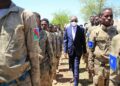
BELED HAWO, SOMALIA – Jubaland intelligence officers took over the army camps at Beled Hawo on Friday 9 October that Abdirashid Janan had held for Mogadishu, and Janan left Mandera that morning on a Kenyan government military aircraft bound for Nairobi, local reports said. The handover closed a standoff of more than a year over the border town without a shot, two months after Janan told his troops that his quarrel with President Ahmed Madobe’s administration was over. Hundreds of residents marched in support of Jubaland, and its presidency thanked the elders who had worked to prevent bloodshed. By Monday 12 October no word on Beled Hawo had come from the government of President Hassan Sheikh Mohamud, which sent Janan to Gedo as its intelligence chief in July 2025.

Janan’s Camps Change Hands
Accounts published on Friday morning said the transfer came after several days of talks between Janan and Jubaland officials, and that it was completed without fighting at any of the positions. Senior officers of Jubaland’s intelligence service arrived at the camps his forces had held and took responsibility for them. Once the arrangements were finished, Janan boarded the Kenyan aircraft in Mandera, the Kenyan town across the border, and flew toward Nairobi, where he was expected to meet Jubaland officials to finalise a preliminary agreement reached in the talks. The forces had been registered with the federal government while he served as the commander of the National Intelligence and Security Agency in Gedo.
Jubaland’s troops then entered Beled Hawo with the administration’s district and regional officials, and hundreds of residents demonstrated in support of Jubaland and the change in the town. Videos shared online showed crowds lining the road to welcome the soldiers as they arrived, and hours after Janan’s departure the media department of the Jubaland presidency issued a statement dated 9 October calling for peace and unity in Beled Hawo district.
The statement thanked elders, women, academics and young people for their part in preventing bloodshed and restoring calm, and it recalled that the district had suffered deadly fighting, casualties, the loss of property and displacement. It urged residents to protect the peace agreements and to avoid anything that could revive the conflict, closing on the line that peace is the foundation of community life, unity and development. It named no official, gave no figures and did not mention the federal government.
Jubaland’s own media listed six terms agreed in Mandera between Janan and Jubaland’s security chief, Mohamed Ahmed Sabriye, known as Basaam, among them that Jubaland takes direct security control of Beled Hawo, enters the forces in the district into its official register and takes responsibility for them, and opens a community reconciliation process. No account gives the number of soldiers or weapons that changed command, and nothing published says who guaranteed the deal or what post, if any, Janan will hold once the Nairobi meeting is over.
From the Camp Speech to the Handover
Mogadishu named Janan its intelligence and security chief for Gedo in July 2025, a government that knew him as Jubaland’s former security minister and as the man who had escaped federal custody in Mogadishu in 2020. Heavy fighting broke out in Beled Hawo on 22 July 2025, a day after a military aircraft carrying him landed in the town, and Jubaland accused the federal government of creating the crisis by sending him. Janan and the forces loyal to him then settled into a camp outside the town, which they held for more than a year.
On Tuesday 11 August 2026 he gathered those forces and told them that his dispute with Jubaland was over, blaming months of unpaid salaries and allowances, and Kismayo agreed to pay what Mogadishu had not. “The soldier’s condition troubles us, and we feel that pain with them,” Janan said, according to a report of the speech, adding that federal soldiers, police and intelligence officers among his men would keep that status. On 22 August Jubaland began registering the Darawish forces stationed near Beled Hawo in its own records.
After talks in Nairobi, with Kenya acting as facilitator, Janan was reported back in Beled Hawo on 16 September to carry out the Nairobi agreement, which concerned the troops and weapons at the camp known locally as UK, and two days later he chaired a security meeting in the town and said the Gedo settlement was close to complete. Then on 5 October the Jubaland-appointed district commissioner said a force under officers taking orders from Mogadishu had set out toward Beled Hawo from Luuq and Doolow, and blamed the federal government for the tension. No independent report confirmed that movement, and four days later the camps passed to Jubaland without a battle.
Janan has now crossed between Mogadishu and Kismayo more than once. He broke with President Ahmed Madobe and reached his own accord with the federal government in 2021, went back to Gedo for Mogadishu in 2025, and has now delivered Mogadishu’s garrison to Kismayo.
Three Towns in Two Days
By one count, Beled Hawo was one of three towns the federal government lost in two days across Gedo, Bay and Hiiraan. On Thursday 8 October Darawish fighters loyal to former South West president Abdiaziz Laftagareen took Qansaxdheere, west of Baidoa, without a gunfight, and part of its garrison went into the Ethiopian army’s camp there. On Friday, the day of the Beled Hawo handover, federal troops fought al-Shabaab at Hees in Hiiraan, and a Mogadishu report published the next evening counted Hees as taken by the group, cutting a supply route toward Beledweyne.
The same report set out who holds Gedo’s towns after Friday. By its count Jubaland now controls Beled Hawo, Doolow, Luuq and El Wak, while forces aligned with the federal government hold Bardere and Garbaharey. That count is disputed ground: the Doolow commissioner said on 7 October that his district would follow the policy of the Ethiopian forces until a capable Somali government exists, and federal officers were reported in Luuq and Doolow only a week ago.
The federal government took most of Gedo’s districts in 2025 and built its presence there around men like Janan, along with the Turkish-trained Gorgor unit it airlifted into Luuq in April 2026 and the officers of the army’s 43rd Brigade. In March 2020 an earlier federal push on Beled Hawo displaced some 56,000 people, most of them toward Doolow and Luuq, and in July 2025 residents fled again as mortars landed in the town. Friday’s change of command, by every account, cost no lives.
Furthermore, Janan was the officer Mogadishu sent to hold its place in Beled Hawo, and the men under him were on the federal register. Their move to Kismayo leaves the federal government without a commander of its own in the town, and no federal statement has said how it intends to answer the loss.
A Kenyan Aircraft and a Nairobi Table
Kenya’s part in the handover shows in every detail of Friday’s accounts. Janan flew out of a Kenyan town on a Kenyan government military aircraft, toward a meeting in the Kenyan capital with officials of an administration Nairobi is widely reported to have backed along the border. Beled Hawo sits opposite Mandera, and its crossing carries much of the trade between the two countries in Gedo, so whoever holds the camps also holds a customs post on Kenya’s frontier. The talks that produced the August settlement were hosted in Nairobi, and the final stage of the agreement is now to be closed there.
Mogadishu has quarrelled with Nairobi over Gedo before, and more than once. In January 2021 the federal government accused Kenya of arming Jubaland’s forces, which Nairobi denied, and this year Kenya barred Deputy Prime Minister Jibril Abdirashid Abdi over claims tied to militias in Gedo. The federal government has said nothing about the aircraft that carried Janan, and no Kenyan official has described its role in the handover.
Mogadishu’s own silence has lasted as long as Nairobi’s. A commentary published on Saturday 10 October noted that the handover does not show that Mogadishu has accepted Jubaland’s position in Gedo, and that the federal response would be the indicator to watch, and by Monday no such response had appeared. President Hassan Sheikh Mohamud’s government has not commented on Beled Hawo, on Qansaxdheere or on Hees, while its forces and the guards of former President Sheikh Sharif Sheikh Ahmed face each other in Mogadishu, amid a dispute over whether its mandate expired in May.
The men in the Beled Hawo camps were paid by Mogadishu, then unpaid, then promised Kismayo’s salaries in August, and on Friday they changed command. The terms of that change, and what Janan negotiates in Nairobi, will decide whether the town stays quiet when the federal government chooses to answer.