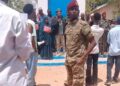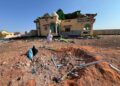


KISMAYO, SOMALIA – Thousands of people filled the streets of Kismayo on Sunday to burn Turkish flags and hold up posters of President Recep Tayyip Erdogan with blood painted across his hands, three days after an aircraft that no government will claim destroyed the Doolow home of a general who had become one of Villa Somalia’s loudest critics. Jubaland’s own ministers marched with the crowd, the administration has asked the United Nations and four other international bodies to treat Ankara as a party to Somalia’s internal quarrel, and a senator has asked the Upper House to summon the ministers of defence and internal security. The partnership that has underwritten President Hassan Sheikh Mohamud for four years is being contested in the open by a member state that has decided the price of foreign air power is charged to its own territory.

The Crowd in Kismayo Names the Aircraft
Demonstrators in Kismayo carried placards reading “Dooni mayno Erdogan” above the same words in English, “We do not want Erdogan”, while others set light to Turkish flags in the road. More than a thousand people gathered separately in Afmadow, in Lower Juba, and the chanting in both towns turned on a reversal the speakers made explicit. “We used to love Erdogan and Turkiye, but now we hate them,” the crowds shouted, in a country where Turkish hospitals, schools and scholarships have been the most visible foreign presence for more than a decade. The placards carried one demand across both towns, that foreign aircraft should have no part in settling arguments between Somalis.
Jubaland’s minister of information, culture and tourism, Abdifatah Mohamed Mukhtar, walked with the marchers and gave the protests the administration’s endorsement in terms no federal official has yet answered. “These protests clearly show the position of the people of Jubaland and their opposition to the use of foreign aircraft and forces in Somalia’s political and security affairs,” he said, before accusing the federal government of a fresh attempt to invade the state. “The federal government has previously failed any kind of invasion of Jubaland, and it has failed again,” he added. “God willing, we will defeat Hassan and his allies. Jubaland knows how to defend itself.”
Garbahaarrey and Doolow had already produced smaller versions of the same scene on Saturday, with residents in both Gedo towns demanding an independent investigation into who flew the aircraft. Three weeks earlier the Turkish flag was burning on farmland outside Baidoa over drone strikes attributed to the same air force, and the crowd there held up the Southwest State flag while it burned. Ankara’s standing in southern Somalia has now been rejected on the street in two member states inside a single month, and on Sunday the rejection reached Kismayo and Afmadow together. Federal lawmakers from both states met in Nairobi on Saturday to endorse the crowds, and MP Hassan Abdinuur read a statement naming the president whose term has expired and the Turkish government as the single threat facing Somalia, warning that Ankara would meet resistance greater than anything it has encountered so far.
A Turkish Warship Ties Up at Mogadishu
The Turkish frigate TCG Goksu, pennant number F-497, entered Mogadishu port on Saturday 5 September as part of the Somali Turkish Naval Task Group, and on Sunday the Turkish embassy in Mogadishu published photographs of its diplomats standing with the ship’s officers on the quarterdeck. The vessel is a regular presence on this station and has spent much of the year in Somali waters. In July the Turkish defence ministry confirmed that Goksu, together with TCG Gelibolu and TCG Bartin, was escorting the drillship Cagri Bey and the support vessels Korkut, Altan and Sancar while they worked the Curad-1 well off the Somali coast. The task group’s remit runs the length of the federal coastline, including the Jubaland shore that reaches south from Kismayo to the Kenyan border.

What the task group protects is an energy programme written on terms Somalia’s parliament never debated. The hydrocarbons agreement lets the Turkish side recover up to ninety percent of its costs before Mogadishu sees a share, caps the royalty at five percent, and sends disputes to arbitration in Istanbul, an arrangement that underwrites a government whose own mandate expired. The Turkish parliament approved a further two-year extension of the deployment in July, carrying it to July 2028 and placing Turkish troops, aircraft and warships in the country well past the end of the current president’s disputed term.
Puntland has spent three weeks making the same argument from the other end of the coast, holding Ankara responsible for the fishermen killed at Garmaal and Jiifle in August and asking how a government can permit a ransom on one stretch of water while bombing the people who fish it. Kismayo has now added a second front to that case, and the two administrations are separated by more than a thousand kilometres and by almost every other question in Somali politics. The naval visit and the burning flags belong to the same weekend, and to the same relationship.
Jubaland Asks the Security Council for the Embargo Back
Jubaland’s information ministry issued a statement on 4 September that went considerably further than a protest. It said the strike on the general’s compound was politically motivated, that it killed civilians working at the property, and that Ankara had abandoned any claim to neutrality in Somalia. “From now on, we will no longer consider Turkiye a neutral party,” the statement said. The administration then asked the United Nations, the African Union, IGAD, the United States and the European Union to open an independent investigation and to review the lifting of the arms embargo, warning that weapons supplied for the war against al-Shabaab are being turned on domestic opponents and on clans in the south. Kismayo issued that appeal two days before its own streets filled.
Resolution 2714 lifted that embargo on 1 December 2023 by unanimous vote, ending a restriction imposed in 1992 and keeping it in force only against al-Shabaab and other armed groups. Mogadishu lobbied for years to reach that vote and presented it as the day Somalia recovered the ordinary attributes of a state. Thirty-three months later a federal member state is asking the same council to put the restriction back, on the argument that the arms have gone where the diplomats promised they would not. The request from Kismayo names no cargo and no consignment, and rests entirely on the aircraft that have flown over Baidoa, the Nugaal coast and now Gedo.
Villa Somalia has denied that any aircraft was involved and says the explosions came from explosives being prepared inside the house, a version Jubaland answers with a claim of two missiles, one of which struck the Doolow district commissioner’s home. Senator Farhan Ali Hussein used Saturday’s sitting to ask the Upper House to summon the ministers of defence and internal security and to establish a fact-finding commission. “Once four were killed by a drone, once ten were killed,” he told the chamber. The federal government has since said it will appoint a committee of its own.
A Cleric Tells the Defence Minister What to Do With Critics
Sheikh Ali Wajis, a scholar who has advised successive administrations and backs this one in public, told a gathering of senior officials on Sunday that opponents of the government should be handled as terrorists are handled. “Anyone who fights Somalia’s current government should face the same punishment as terrorists and should be killed,” he said. The minister of defence was in the room when the sentence was delivered, seated among the senior officials who had come to hear the sermon. No official who attended has distanced the government from the remarks, the ministry has said nothing since, and Villa Somalia has issued no response of any kind. The words reached Kismayo on the same day the crowds there were burning flags.
Wajis made a similar intervention in April, when desertions were thinning the army during al-Shabaab’s offensive in the Shabelle valleys, and he branded the soldiers who left their posts apostates. A senior Custodial Corps commander followed him within days by warning that deserters and their families faced arrest or execution. The Custodial Corps was then commanded by General Mahad Abdirahman Aden, the officer whose house in Doolow was hit on Thursday night. He was removed from that command in March, held under house arrest for a week, and has spent the months since building a case against the government he spent his career serving. He now sits in a hospital across the Ethiopian border.
Baidoa supplied the template in August, when the federal government counted the militia dead of a political revolt as Khawarij and displayed the bodies as an al-Shabaab loss. Jubaland, Puntland and the ousted Southwest administration have all rejected the constitutional amendments extending federal mandates and have suspended relations with Mogadishu. Banadir governor and Mogadishu mayor Hassan Mohamed Hussein, known as Muungaab, spent Monday organising a counter-demonstration in the capital at which marchers are to carry both flags and mark fifteen years of Turkish assistance. The aircraft, the terrorist label and the cleric’s licence arrived in the same week, and the crowd in Kismayo drew the connection between them before any Somali institution did.