BAIDOA, SOMALIA – President Hassan Sheikh Mohamud has ordered the Somali National Army to mount an operation driving forces loyal to the removed Southwest leader away from Baidoa, and fresh troops are being assembled for deployment into the Bay region after a telephone call between the president and the man Villa Somalia installed in the city in June. The order closes a six-month sequence in which a military seizure, a managed vote, a terrorism designation and a package of financial sanctions each failed to settle who governs Southwest State. It commits an army already short of money, aircraft and international logistics to a second front in a countryside where al-Shabaab moves at will. Mogadishu is opening a war of choice in the one region where its own commandos were fighting a war of necessity five days ago.

The Order and the Telephone Call Behind It
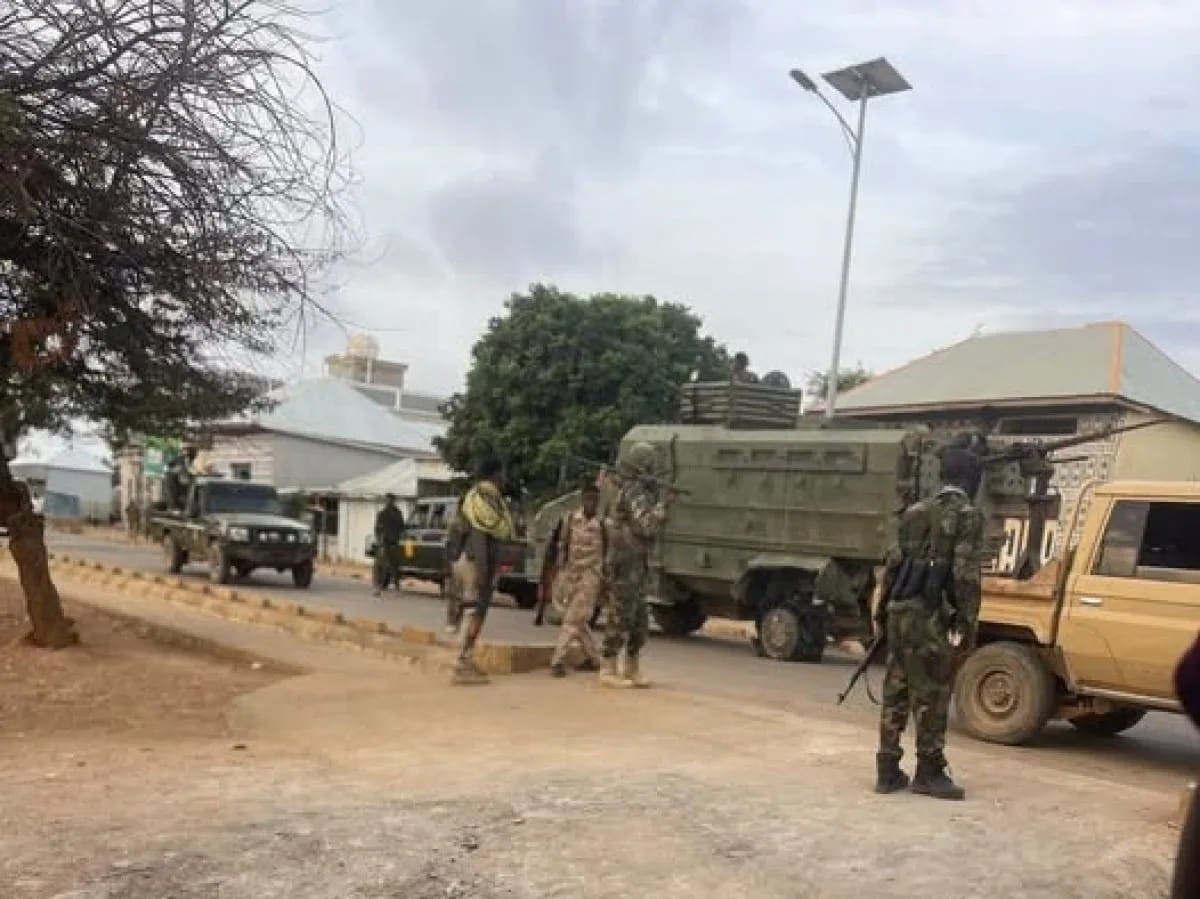
The instruction reached the Somali National Army command as a requirement to reinforce the federal troops already stationed in and around Baidoa, and to prepare an operation pushing opposition fighters farther from the positions they use to organise their attacks, according to people familiar with the planning. It followed a telephone conversation on the deteriorating security situation between President Hassan Sheikh Mohamud and Adan Mohamed Nur, the Southwest State leader universally known as Adan Madobe. Fresh units are being drawn from Southwest districts for movement into the city. The declared purpose of the exercise is to drive the battle zone out of Baidoa and stabilise the town.
Adan Madobe’s difficulty is the ring of fighters loyal to Abdiaziz Hassan Mohamed Laftagareen holding ground on the outskirts, from which they have struck inside Baidoa on a weekly basis through the past three weeks. Driving the battle zone away from the town means driving it into the Bay region countryside, an objective that describes a government holding a single urban centre and contesting everything beyond its perimeter. Six months after federal soldiers took the city, the administration they installed cannot secure the road out of it. The Bay region districts that supply Baidoa with grain, livestock and labour all sit on the wrong side of that line.
The most serious of those attacks came on 3 September, when Laftagareen’s fighters entered the town from several directions before withdrawing, briefly overrunning two federal army bases on the edge of the city. Among the dead was the commander of Adan Madobe’s personal guard, and the commander of the army’s Eighth Brigade was seriously wounded. Bay Regional Hospital took in seventy one casualties including fifteen women and twelve children, in a town whose leadership was settled in Mogadishu and not in Baidoa. Talks between Laftagareen and Villa Somalia are reported to be continuing while the reinforcements are assembled, which leaves the federal government negotiating with a man its own partners in the city have publicly designated a terrorist.
Five Instruments in Six Months
Laftagareen governed Southwest State from 2018 until a federal military offensive took Baidoa on 30 March this year, and he resigned within hours of its arrival. Villa Somalia grounded flights into the city in the weeks beforehand and his administration relocated to Nairobi. By early June a managed vote had installed Adan Madobe, the former speaker of the federal parliament and a reliable ally of the president, in the seat Laftagareen had vacated. The instrument was force and the ratification was electoral, a sequence the Bay region had already watched run once before.
Adan Madobe convened an extraordinary cabinet meeting at the end of August at which his administration announced it had identified evidence of cooperation between Laftagareen and al-Shabaab, and said it now regarded the former regional president as associated with the group. No material supporting that allegation has been produced publicly, and roughly two weeks of federal attempts to bring Laftagareen into negotiations had already failed by that point. The defence ministry had filed the thirty or so dead of the 17 August battle as Khawarij, a count that former Baidoa officials examining the same photographs identified instead as Laftagareen’s own Darwish. Adan Madobe’s administration went on to call for the dispute to be settled through dialogue.
The financial instrument arrived on 8 September, when federal officials were reported to be weighing asset freezes against Laftagareen and his former administration, together with passport withdrawals for his political camp. Officials from the finance and internal security ministries, the police, the immigration agency and the National Committee for Countering Money Laundering worked those measures out between them. Twenty four hours later the military instrument returned, which is where the whole sequence began in March. Each measure has been introduced because the previous one failed, and each has widened the constituency across the Bay region that reads the administration in Baidoa as something imposed from the capital.
The Other War in the Bay Region
On Saturday 5 September, five days before the reinforcements were ordered, the defence ministry announced that Somali army units including Danab commandos had killed fourteen al-Shabaab fighters in an overnight operation at Buula Fulaay in the southern Bay region. The same statement said the troops had destroyed a hideout the group had been using. Danab has been working the countryside around Buurhakaba in the same region through the summer, a district that changed hands on 8 August when the Ethiopian contingent that had garrisoned it for twelve years handed its positions to Somali forces and left.
Warplanes struck the Baidoa outskirts overnight on 7 September, reportedly hitting a gathering of al-Shabaab commanders and destroying weapons and vehicles, with no government claiming the aircraft and no casualty figure published. The United Nations logistics platform that supplies the African Union mission with fuel, rations, casualty evacuation and air transport expires on 31 December, and Washington withheld its support for that office on 1 July. The federal government has declared itself ready to take the ground back, without naming what will replace roughly half a billion dollars a year in logistics for some twelve thousand African Union personnel and twenty thousand Somali troops.
Bay region is carrying two campaigns at once, and only one of them is against the insurgency the international financing was raised to fight. The soldiers moving toward Baidoa this week come from the same force that was clearing hideouts at Buula Fulaay last week. The fighters they are being sent to engage were Somali government troops six months ago, who followed a president out of office. Al-Shabaab has no need to contest Baidoa itself while the units assigned to the Bay region are committed to fighting each other around it, and every district returned to Somali control before December will be held by the brigades being spent on this.
What More Soldiers Cannot Decide
Laftagareen’s fighters operate across terrain they know intimately, in villages where a substantial part of the population regards them as a community force resisting an arrangement imposed from Mogadishu. They describe their campaign as the liberation of Southwest State from troops sent out of the capital, and they have warned residents of the Bay region against cooperating with the garrison in Baidoa. Their mobility, their local intelligence and the sympathy of the villages have so far offset a federal force with better weapons and air support behind it. Federal reinforcements can retake ground and clear the approaches to the town, and the fighters can withdraw into the districts beyond and return within a fortnight. That is the pattern the past three weeks have already established.
A survey of Baidoa’s displacement sites in July found one child in four severely malnourished, in a town that had been comparatively quiet under Laftagareen and has spent the summer as a battlefield. Families are now leaving for the surrounding villages to escape the fighting, which is precisely where the offensive is designed to push it. The humanitarian cost of the campaign will be paid in the same Bay region settlements the operation intends to turn into its front line, by people who have already moved once.
What the deployment cannot supply is an answer to the question underneath the fighting, which is who holds the authority to govern Southwest State and who decides it. Mogadishu has answered four times since March by removing the incumbent, installing a successor, designating the loser a terrorist and moving against his money. It is answering a fifth time with an army it cannot afford to keep in the Bay region for long. The federal government has spent six months and a great deal of ammunition demonstrating that it can take Baidoa, and it has yet to demonstrate that it can govern the region the city sits in.