DHUSAMAREB, SOMALIA – President Hassan Sheikh Mohamud’s Justice and Solidarity Party won 67 of the 89 seats in the Galmudug House of Representatives and 179 of the 243 local council seats in the rerun the Supreme Court ordered when it annulled the state’s July election, according to results the electoral commission’s chairman, Abdikarim Ahmed Hassan, announced in Dhusamareb on Friday 2 October. Towfiiq, the party that brought the case and won it, was left off the ballot for the vote of Wednesday 30 September, and the twelve assembly seats it was awarded in July have gone to the ruling party and its smaller rivals. The new chamber is the body that will elect Galmudug’s next president, and the Justice and Solidarity Party chose its candidate, Liban Ahmed Hassan, known as Shuluq, before the first ballot was cast in July.

Sixty-Seven Seats for the Justice and Solidarity Party
The commission put the number of ballots cast across Galmudug’s eleven districts at 149,475, of which 146,374 were valid in the vote for the state assembly. The Justice and Solidarity Party took 110,072 of those votes, roughly three in every four, while Sincad and Karaama followed with seven and six seats on a little over 10,000 votes each. In the council vote the ruling party won 105,716 of 146,894 valid ballots and 179 seats, against 21 for Karaama and 17 for Sincad, out of twelve organisations on the list. The results were announced in Dhusamareb two days after polling, in the presence of the commission’s chairman.
In July the same commission awarded the Justice and Solidarity Party 63 assembly seats, Towfiiq twelve, Sincad six and Karaama five, and in the council count it gave the ruling party 135,247 of 193,451 valid votes against 26,003 for Towfiiq. It had enrolled 215,860 voters across Galgaduud and Mudug before that first polling day. Towfiiq rejected the July returns, published its own tally claiming 47 assembly seats and took the commission to the Supreme Court, where a five-judge electoral division heard the petition from 17 to 19 August.
Chief Justice Bashe Yusuf Ahmed delivered the judgment on 24 August, finding that the July election had breached the constitutional requirements of freedom, fairness and impartiality, and that the breaches had affected the result. The court annulled both tiers of the vote, ordered a fresh election under the Constitution and the electoral law, and kept Galmudug’s existing institutions in office until lawfully elected replacements could take over. It handed the rerun back to the commission whose conduct it had just found wanting, and it appointed no independent supervisor and ordered no outside observation. Between the two ballots the Justice and Solidarity Party lost almost 30,000 council votes and gained four assembly seats, while the number of valid ballots in the council vote fell by more than 46,000.
Towfiiq Kept Off the Ballot It Won in Court
On Sunday 13 September the commission announced that submissions had closed and named twelve organisations for the 30 September vote, the Justice and Solidarity Party among them, with Towfiiq absent from the list. Its spokesman, Abdifatah Faisal Hussein, said two days later that Towfiiq had filed no formal application, and the commission later cited a 12 September deadline for candidate lists. Towfiiq answered that the commission already held its candidate lists for both bodies, that it had received no written decision and had learned of its exclusion on social media. In a statement on 14 September the party called the exclusion retaliation for its court case, urged President Hassan Sheikh Mohamud to intervene and told its supporters to prepare peaceful gatherings and demonstrations.
At a news conference on Saturday 26 September, four days before the Justice and Solidarity Party faced the voters without July’s runner-up on the ballot, Towfiiq’s leader, Sheikh Shakir, called the exclusion an abuse of power and asked for it to be reversed. “The Galmudug election is of great importance to Towfiiq. The decision should be revisited and given special consideration,” he said, and the commission had not responded by the following day. Its calendar squeezed the whole rerun into a single month, with polling centres marked on 10 September, candidate lists published on 20 September and accreditation completed on 26 September. The electoral law the Supreme Court cited requires ninety days’ notice of polling and candidate lists lodged 120 working days before the vote.
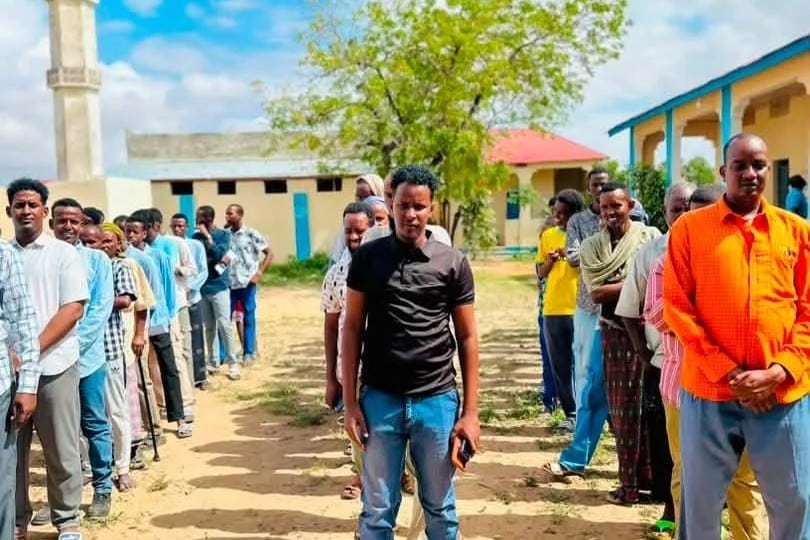
Polling went ahead on Wednesday 30 September across the eleven districts. In Balanbale, one of them, the vote was disputed after Towfiiq rejected the holding of the election in the district. By Friday the director of the National Intelligence and Security Agency, Mahad Salaad, was in Dhusamareb for meetings with politicians, elders, businesspeople, women and young people that dwelt on the conflict in Balanbale district and on reconciliation between the clans, and those who attended thanked him for his work to end the recent violence. Towfiiq’s political base lies largely in Dhusamareb and Guriceel, two of the eleven districts where the Justice and Solidarity Party contested the councils without it, and Mahad Salaad was meeting elders and politicians in the first of those towns in the week the results were read.
The Chairman Galmudug Accused in June
Abdikarim Ahmed Hassan, who read out the results, is the chairman the Galmudug government accused on 16 June of abandoning his neutrality and campaigning for Liban Ahmed Hassan. A day earlier the state’s information minister, Ali Mohamed Farah Seeko, had said Galmudug would reject any election arrangement imposed without a political agreement, and that an election like the one held in South West State would not happen in Galmudug. In South West the state assembly elected President Aden Mohamed Nur Madobe by 88 votes to one on 10 June, three months after federal forces took Baidoa and President Hassan Sheikh Mohamud removed former President Abdiaziz Hassan Mohamed Laftagareen.
On 25 June Galmudug’s sitting leader, President Ahmed Abdi Kariye, known as Qoorqoor, withdrew from the race after talks with federal officials. By then the Justice and Solidarity Party had settled on Liban Ahmed Hassan as its only candidate for the state presidency. Liban Ahmed Hassan is a former militia commander from Galkayo South whom President Hassan Sheikh Mohamud had appointed to oversee military logistics in Galmudug, and the party named him before the voters had chosen the assembly that would elect him. The Qiimo Qaran party has since endorsed him as well, and under the court’s order President Ahmed Abdi Kariye’s administration stays in place until a lawfully elected successor takes over.
Accordingly, the rerun gives the party that nominated Liban Ahmed Hassan three quarters of the chamber that will vote on him, four seats more than the July result the Supreme Court threw out. Sincad, Karaama and the other organisations that won seats hold 22 between them. In the councils the Justice and Solidarity Party holds 179 seats against 64 for everyone else across the eleven districts of Galgaduud and Mudug that voted, the same districts where the Supreme Court annulled the July council results. Towfiiq, the only organisation that challenged the July count in court and won, holds no seat in either body, and it had asked President Hassan Sheikh Mohamud, the leader of the party that now dominates both, to intervene on its behalf.
Hirshabelle Voted on the Same Wednesday
Hirshabelle elected its own councils and assembly on the same Wednesday, under the same commission, after the Justice and Solidarity Party gave President Ali Gudlawe Hussein its only card for the state presidency. Hundreds of people marched in Beledweyne against the vote that day, in a protest organised by politicians opposed to his candidacy who demanded an arrangement agreed by all stakeholders. Hawadle leaders have pressed for months for the presidency to pass to their community, and political sources say President Hassan Sheikh Mohamud had promised it to them once President Ali Gudlawe Hussein’s term ended. Armed Macawisley fighters occupied voter registration centres in Beledweyne in early September, and elders barred Hirshabelle officials from landing at airports in Hiiraan until a deal was reached.
President Ali Gudlawe Hussein cast his own ballot in Jowhar and called it a historic day for Hirshabelle and for Somalia, and the commission’s deputy chairman, Saadiq Abshir Garaad, said no security incident had disrupted polling in either state. Banadir and South West went first, and Galmudug and Hirshabelle are the third and fourth administrations to hold direct elections under the same commission inside ten months. Each of those contests has strengthened the Justice and Solidarity Party or advanced a state presidency arranged in Mogadishu. President Hassan Sheikh Mohamud’s own four-year term ran out in May, and no model for a national election has been agreed with Puntland, Jubaland or the opposition since.
In July the commission’s count gave Towfiiq more than 26,000 council votes and twelve seats in the Galmudug assembly, and its October count gave the party nothing, because Towfiiq was missing from the list it published on 13 September. The chamber that will elect Galmudug’s next president now seats 67 members of the Justice and Solidarity Party, which named its candidate before the first vote in July, and the man who declared them elected is the commission chairman Galmudug’s own government accused in June of campaigning for that candidate.