

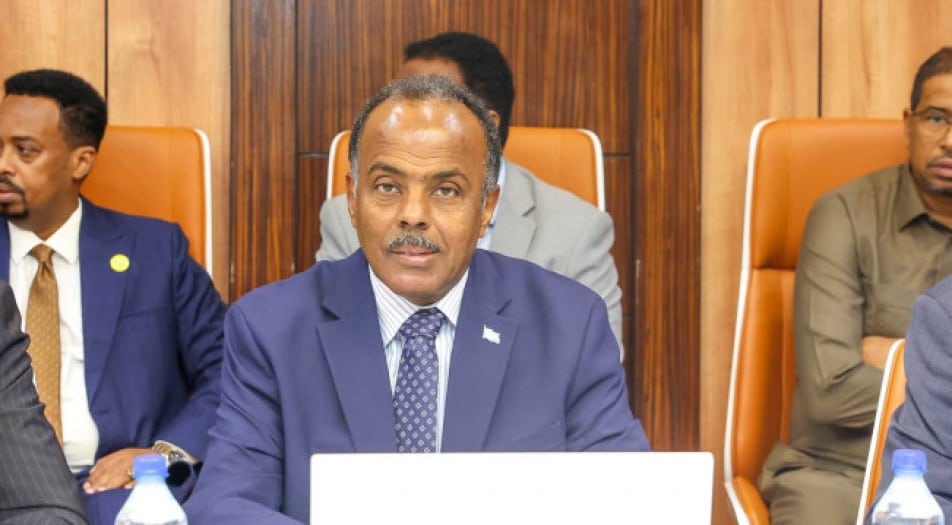
MOGADISHU, SOMALIA – Somalia’s state minister for foreign affairs, Ali Mohamed Omar, said in an interview published on 2 September that the Ankara Declaration is now the framework governing relations between Somalia and Ethiopia, and that Mogadishu sees little value in continuing to argue about whether the Ethiopia and Somaliland memorandum has been suspended, abandoned or is still alive. He said Ethiopia can obtain reliable access to the sea through Somalia on commercial terms that respect Somali sovereignty, and that technical negotiations mediated by Turkiye had already shown as much. The position is a reasonable one and it is also a concession, because the instrument Mogadishu is relying on to settle a question about Somali territory was drafted, hosted and is guaranteed by a foreign capital.

What the Minister Actually Said About Ethiopia
“The Ankara Declaration is now the framework governing relations between Somalia and Ethiopia,” Omar said, and the wording is the policy, describing an agreement signed in Ankara on 12 December 2024 in which both governments reaffirmed a commitment to respecting each other’s sovereignty, unity and territorial integrity. He said the technical talks that followed, with Turkiye in the chair, had demonstrated that Addis Ababa’s need for dependable commercial access to the sea could be met through a legal arrangement that leaves Somali sovereignty intact. Two years earlier the same ministry was recalling ambassadors over the question.
Mogadishu, he indicated, does not consider it worth spending significant time on whether the 1 January 2024 understanding between Ethiopia and Somaliland was suspended, dropped or remains technically in force, because the Ankara process and the negotiations under it are what now matter, and the memorandum belongs to a period Mogadishu would prefer to treat as closed. That is a considered piece of diplomacy, since arguing about the status of a document keeps the document alive in the conversation, and declining to argue is a way of treating it as already overtaken. A government that debates whether a rival instrument is still in force concedes that the question remains open, which is precisely the concession Mogadishu has spent two years refusing to make.
Ethiopia is landlocked, its need for maritime access is real, and Somalia has never denied either fact in nearly three years of argument; what Mogadishu rejects is any arrangement negotiated with a regional administration instead of the federal government, and any arrangement that trades territory or grants a foreign military a coastal foothold. Omar restated both halves without hedging either. That consistency stands out in a month when very little else the federal government did held its shape from one week to the next, and it reflects the one position on which every Somali faction agrees, including the ones currently trying to remove the president.
The Document That Started It
The memorandum signed on 1 January 2024 remains the most serious external challenge to Somali territorial integrity in a generation. Under the terms announced at the time, Ethiopia was to lease about nineteen kilometres of Somaliland’s Gulf of Aden coastline for commercial and military use, and Somaliland said the arrangement would open the way to broader cooperation, which was widely understood to mean movement towards recognition. Mogadishu condemned it as a violation of its sovereignty, recalled its ambassador and spent most of that year assembling regional and international backing against it, an effort that succeeded well enough that no state of consequence ever endorsed the arrangement.
Somaliland’s own position has not changed either, since the administration that declared independence in 1991 maintains that it holds the authority to sign agreements concerning the territory it governs, and Somalia continues to reject that claim and to insist that foreign states deal with the federal government on anything touching Somali soil. Hargeisa has gone further and said the memorandum with Ethiopia remains intact notwithstanding the declaration, which is a flat contradiction of the position Mogadishu has just restated. Neither side has conceded the principle, and neither is likely to. What has happened instead is that the practical question, Ethiopian access to a port, has been lifted out of the sovereignty dispute and moved into a negotiation where the sovereignty question is stipulated at the outset instead of contested throughout.
Ethiopia and Somalia restored relations, the border remains open, Ethiopian troops continue to serve in the African Union mission with a contingent of around 2,500, and the confrontation that looked in early 2024 like it might produce a shooting war did not produce one, which is a diplomatic achievement belonging to the government that secured it. Mogadishu has reason to point at the Ankara Declaration and call it a success, and the reasonable objection concerns what the success rests on. Ethiopia gained a process, Somalia gained a restated principle, and the port that started the argument has still not changed hands or changed status. That is a de-escalation, and calling it a settlement would be premature.
Whose Filing Cabinet Holds Somali Sovereignty
The framework governing Somalia’s relations with its largest neighbour is named after somebody else’s capital city. It was brokered by Turkiye, signed in Turkiye, and the technical negotiations that followed have run with Turkiye in the chair and Turkish officials setting the agenda, which means that the mechanism by which Somalia defends its territorial integrity against an Ethiopian claim depends on the continued interest and goodwill of a third government. Ankara has been an effective and, on this file, a genuinely useful partner, and dependence on a useful partner remains dependence. A guarantee lasts only as long as the guarantor keeps an interest in providing it, and Turkish interests in the Horn are broader than Somalia and older than this dispute. Ankara sells drones to Ethiopia as well, trains officers in both capitals, and has commercial stakes on either side of a border it is currently mediating.
Puntland has accused Turkish aircraft of killing thirteen people on the Nugaal coast and destroying fishing dhows, Turkish F-16s were reported bombing riverbank positions thirty kilometres from Mogadishu on 31 August, and neither Ankara nor the federal government has confirmed a single one of those sorties. Two divergences of interest inside one fortnight, and neither was acknowledged by the party doing the diverging. A state that cannot get its guarantor to acknowledge bombing its territory is in a weaker negotiating position than the phrase “framework governing relations” suggests, and the federal government has spent the fortnight demonstrating that it either cannot ask or will not.
The pattern extends well past Turkiye, since Uganda has named 1 August 2027 for the withdrawal of its entire contingent, Washington signed directly with Puntland for an expanded presence at Bosaso, and the mission’s funding is blocked past 31 December. Each of those decisions was taken elsewhere and communicated to Mogadishu afterwards, and one of them was negotiated with a federal member state directly. The Ankara Declaration belongs to the same species of arrangement, with the single difference that this one currently runs in Somalia’s favour.
A Framework Is Not a Coastline
Nearly two years after the declaration was signed, Ethiopia still has no port agreement and no commercial maritime access through Somalia, no route has been named, no terms have been published, no tonnage has been discussed publicly and no timetable has been set, which leaves the arrangement resting on a stated principle and a negotiation that has demonstrated a possibility. Omar’s confidence that Addis Ababa’s needs can be accommodated legally is probably correct, and it has not yet been tested by anyone signing anything. A framework that has produced no berth, no corridor and no tariff schedule after twenty months is a statement of intent wearing the clothes of an agreement.
Ethiopia has meanwhile lost none of its motivation, being one of the world’s largest landlocked countries with a population above a hundred and twenty million and an economy that pays a heavy premium for routing almost all of its trade through Djibouti. A government under that pressure will keep looking for alternatives, and if the Somali route stays theoretical for long enough, the Somaliland route becomes interesting again regardless of what any declaration says about it. Berbera has a functioning deepwater terminal, an operator with capital behind it and an administration eager to sign, which is a combination Somalia cannot presently match anywhere on its own coast.
Mogadishu is therefore relying on three things it does not control, which are Turkish patience, Ethiopian restraint and the passage of time. It has the better legal argument, the recognised sovereignty and the support of most of the international system, and it lacks the port, the signed commercial terms and any independent means of enforcement. Declaring the memorandum irrelevant is the correct posture. Making it irrelevant would require Somalia to offer Ethiopia something concrete, through a Somali harbour, on paper, with a date.


