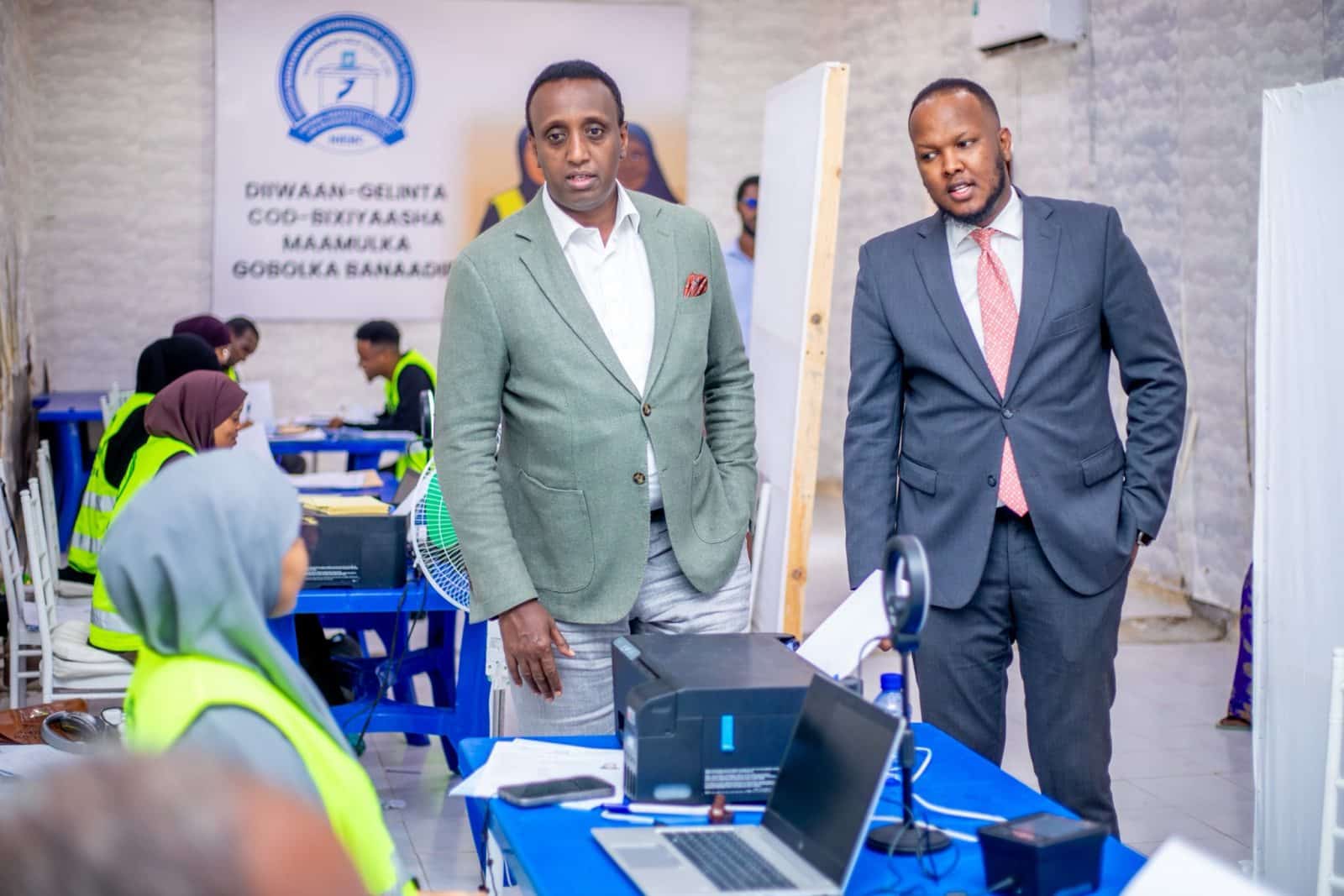
MOGADISHU, SOMALIA – Abdikarim Ahmed Hassan, the chairman of the National Independent Electoral and Boundaries Commission, said on Saturday 17 October that federal parliamentary seats belonging to areas where no vote can be held, or which stay out of the process, can be represented by seats won elsewhere, because the commission will run the 2027 elections as one national constituency. His examples were a seat elected in Karaan, Galkayo or Baidoa standing for the whole country. Puntland and Jubaland have taken no part in the process, and the chairman spoke two days after his commission set the parliamentary vote for 15 April 2027 and the presidential vote for 15 May, three weeks after Prime Minister Hamza Abdi Barre described the same mechanism, and a day after Puntland’s leadership warned that the state would decide its own future.

Abdikarim Ahmed Hassan and the Single Constituency
The chairman set out the rule in plain terms: the system the commission is preparing rests on a single electoral constituency covering the whole country, so a seat in the federal parliament represents the nation, and its representation is no longer confined to the place that elected it. Abdikarim Ahmed Hassan added that voting would take place wherever the commission can reach, and that insecurity closes some parts of the country to it while in others the authorities lack the capacity to hold elections at all. His commission’s task, he said, is to implement the elections the law sets out; local council and state assembly elections in several administrations are already complete, and the preparations have now moved to the federal level.
Voters in the 2027 elections will choose parties, and the ballots will be pooled nationally. Each party then takes seats in proportion to its share of the total vote. The party lists for both houses must also follow the 4.5 clan power-sharing formula, which means the clan quota attached to a seat can be met by a candidate placed on a list in Mogadishu and elected on ballots cast in Banadir or Bay. Consequently, the federal parliament can be filled in full even if large parts of the country never open a polling station.
More than 660,000 people voted at more than 870 polling centres in Banadir, South West, Galmudug and Hirshabelle, with more than 30 political associations competing, and registration of voters and associations reopens from 1 to 22 November. Every one of those ballots was cast in an administration that accepted the commission and the amended constitution behind it. Abdikarim Ahmed Hassan’s own three examples fall inside the same territory: Karaan is a district of Mogadishu, Baidoa is the South West capital where the commission ran its May vote, and Galkayo is the city Puntland and Galmudug divide between them.
A Formula the Prime Minister Announced First
Prime Minister Hamza Abdi Barre described the same arrangement on 27 September, speaking on a Mogadishu podcast about Jubaland. “The election will take place, and it will happen wherever it can,” he said, and he named Jilib, Bu’aale, Hagar, Jamaame and Badhaadhe as places where direct voting might prove impossible, proposing the single-constituency framework for any seat or area the polls could not reach. He cited Iraq and Afghanistan as countries where other arrangements had covered districts unable to vote. Three weeks later the chairman of the National Independent Electoral and Boundaries Commission set out the prime minister’s plan in nearly the same words.
Abdikarim Ahmed Hassan was part of the campaign team for President Hassan Sheikh Mohamud’s 2022 election. When the commission’s 18 members, approved by both houses of parliament, chose him as chairman on 2 December 2024, opposition parties and civil society groups questioned the appointment because of his closeness to the president, while the government replied that he had been chosen for his competence and experience. Since then the Galmudug government has accused him of abandoning his neutrality and campaigning for Villa Somalia’s preferred candidate, in a statement of 16 June. Afterwards the Supreme Court annulled the July Galmudug vote his commission had run, leaving the same chairman to administer the replacement.
That rerun ended on 2 October with the Justice and Solidarity Party, President Hassan Sheikh Mohamud’s own party, taking 67 of the 89 seats in the Galmudug House of Representatives, results Abdikarim Ahmed Hassan read out in Dhusamareb two days after polling. He returned there on Thursday 15 October for the swearing-in of the 89 members of the new assembly, a day after his commission set the Galmudug Speaker’s election for 18 October and the state presidential vote for 22 October. On Sunday 18 October that assembly elected Hussein Mohamed Nur of the same party as Speaker by 79 votes to eight, and the party took both deputy speaker posts as well. Every completed stage of the federal calendar has so far been held in administrations that accepted the commission.
Puntland and Jubaland Outside the Count
Puntland holds that constitutional amendments of this weight required consultation with the federal member states, and that a parliament in Mogadishu could not approve them on its own. Vice President Ilyas Osman Lugatoor, acting as president, held President Hassan Sheikh Mohamud responsible on 16 and 17 October for undermining the political agreements on which the federal system rests. He said federal authority reaches only parts of Mogadishu while al-Shabaab holds ground near the capital, and he warned that Puntland would decide its own future if efforts to preserve Somalia’s statehood failed, adding that the state remains committed to unity.
Puntland has its own constitution, laws and institutions, and its government argues that they allow it to govern itself until a national agreement is reached. President Said Abdullahi Deni put the same grievance in writing in September, when Puntland wrote to the Security Council that it would act independently until a government formed by consensus took office. Under the formula Abdikarim Ahmed Hassan described, by contrast, the seats Puntland’s voters would have filled can be won on ballots counted in Mogadishu, Baidoa and Dhusamareb, by candidates on lists drawn up in Mogadishu, while the government in Garowe has no vote on who sits in its name.
Saadiq Abshir Garaad, the deputy to Abdikarim Ahmed Hassan at the commission, was a member of the Puntland parliament when he was named in December 2024. Jubaland, for its part, is absent from the process as well, and the five towns the prime minister listed in September all lie in the Juba valley, where al-Shabaab holds Jilib and Bu’aale and Jubaland, which broke with Villa Somalia after its own election in November 2024, administers much of the rest. Meanwhile the commission has published no figure for how many seats in the House of the People belong to the areas it cannot reach, and Abdikarim Ahmed Hassan offered none on Saturday.
Seats Without Voters From Hargeisa to Kismayo
On 29 September 2021, 46 delegates from the Somaliland regions gathered in Mogadishu and elected six senators for a territory whose government accepts no federal authority. That arrangement belonged to the indirect clan model, in which elders picked the delegates and the delegates picked the members, that the 2026 constitution was supposed to retire, and it kept Somaliland’s seats filled by people who were chosen without any vote in Hargeisa, Burao or Borama. The single national constituency Abdikarim Ahmed Hassan described now offers the same solution to two federal member states, Puntland and Jubaland, which sit inside the federation and refuse the process.
Hargeisa has spent the past year gathering recognition, from Israel in December to its own embassy in Jerusalem in June. Mogadishu has answered each step by insisting that it speaks for every Somali region, Somaliland included. A federal parliament whose Puntland and Jubaland seats are filled from ballots cast in Banadir, Bay and Galmudug would place two more member states in the position Somaliland already occupies, represented in the capital by people their own governments never accepted.
The Salvation Forum, the main opposition coalition, called the timetable election theft within hours of its publication on 15 October, former President Mohamed Abdullahi Farmaajo warned of rival elections, and former President Sharif Sheikh Ahmed filed a petition on 11 October asking the Supreme Court to rule on the constitutional changes behind it. A group of lawmakers has since urged the opposition to draw up an alternative election schedule of its own. On Sunday 18 October the deputy information minister, Abdirahman Yusuf Alcaddaala, answered that the government remains committed to the one-person-one-vote model already used in Banadir and several administrations, and that the door to dialogue is open.
Furthermore, the ground on which the commission proposes to vote is moving: Baidoa, one of the three towns Abdikarim Ahmed Hassan offered as a seat that can stand for the whole country, now sits beside Qansaxdheere, Buurhakaba and Bardaale, three Bay districts that forces loyal to former President Abdiaziz Hassan Mohamed Laftagareen have claimed since the second week of October.