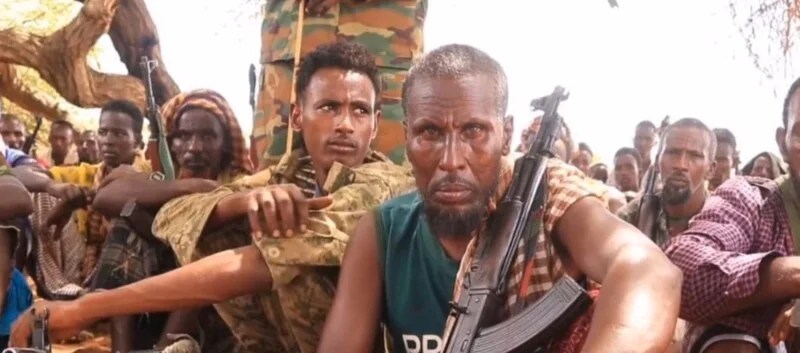
MOGADISHU, SOMALIA – The commander of the Somali National Army is weighing a return to uniform for Ali Jeyte Osman, the twice serving Hiiraan governor whose 2022 clan uprising cost al-Shabaab more ground than any federal offensive since, as the group tightens its hold on the eastern districts of the region and the army struggles to keep the corridor between Maxaas and Teedaan open. General Ibrahim Mohamed Mohamud is considering recalling Ali Jeyte into active service to lead the Macawisley, a step that would need the approval of the same federal government that spent two years quietly hollowing out the office it gave him for exactly that purpose.

A Commander Short of Options in Hiiraan
Pressure on the eastern half of Hiiraan has been building since last year, and the army’s position there has narrowed to a set of garrisons joined by roads it does not control. Al-Shabaab moves fighters and supplies between the southern and central regions through that ground, and the federal command has spent months trying to sever the corridor without the numbers to hold whatever it clears. Teedaan fell at the start of August after a single day of fighting, and the brigade that lost it had been asking for ammunition and water for weeks before the assault came.
The operations that followed exposed the shape of the problem. Federal troops and Macawisley militiamen encircled al-Shabaab units between Maxaas and Teedaan on 2 August, with warplanes striking the group’s positions and vehicle bombs detonating on the forward trenches, and neither side produced a casualty figure that could be checked independently. A similar sequence ran through July, when strikes near Suullaay, some seventeen kilometres south of Teedaan, killed eighteen fighters and wounded twenty one. The group absorbed the losses and came back into the same ground within days.
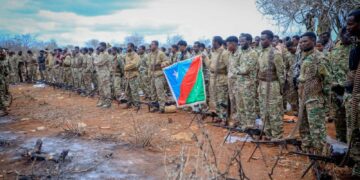
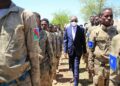
Officers at army headquarters in Mogadishu describe a very short menu of remedies. Reinforcing Hiiraan from the south would thin Lower Shabelle at the precise moment the African Union mission is handing its bases back and auctioning its logistics fleet. The Turkish trained battalions arrive home in company strength and go directly into the defence of the capital. What remains is the militia option, and the militias of Hiiraan have one name attached to them. Ali Jeyte raised those fighters, armed them and led them into the field, and the officers who fought beside him say the men still answer to him more readily than to any brigade commander posted north from the capital.
What Ali Jeyte Built in 2022 and What Mogadishu Did With It
In September 2022 Ali Jeyte, then governor of Hiiraan, organised a popular revolt against al-Shabaab that began in his own region and spread within weeks into Middle Shabelle, Galguduud and Mudug. The army advanced behind the clan fighters instead of ahead of them, and across 2022 and 2023 the two forces together drove the group out of roughly seventy percent of the territory it held in Hirshabelle and Galmudug. Military analysts took from the campaign a straightforward conclusion about how quickly the group collapses when a mobilised population moves against it, and about how little of that collapse depends on the quality of the regular army standing behind them.
The offensive then stalled, and most of the ground taken in those fifteen months has since returned to the men who lost it. Moqokori, Mahas and now Teedaan have all changed hands twice, and each recovery cost the federal side more than the original capture. Villa Somalia’s answer to the man behind the uprising was to bring him indoors. On 29 October 2023 President Hassan Sheikh Mohamud appointed Ali Jeyte presidential liaison for Civilian Defence Forces affairs, an office carrying a title, a salary and a corridor inside the presidency.
The appointment closed a confrontation the presidency preferred to absorb. Ali Jeyte had declared himself president of an unrecognised Hiiraan state, issued decrees naming his own commanders and drawn police units in Beledweyne away from the Hirshabelle administration. The federal government had no appetite for a second front in a region it needed as a staging area for the war further south. Folding him into the palace removed a rival authority from Beledweyne at a stroke. It also placed the architect of the only successful counter-insurgency Somalia has run in a decade under the supervision of a presidency whose attention was already moving somewhere else.
The Two Years Ali Jeyte Spent on the Shelf
The liaison office was never resourced to command anything. Over the two years that followed, the authority attached to it thinned steadily as Villa Somalia shifted its energy to amending the provisional constitution and to building an electoral machinery it could rely on, and the Macawisley were left to fight in their districts without a coordinating headquarters, a supply chain or a payroll. Clan fighters who had been promised integration into the national army waited, and many drifted home or into local arrangements with whoever was collecting taxes on their road.
The bill for that neglect arrived in the form of towns that had already been won once. Every settlement recovered in the uprising and lost again since 2024 was retaken from a force that had stopped receiving the one thing the campaign ran on, which was the sense that the government in Mogadishu was fighting the same war they were. Meanwhile the political calendar filled up and absorbed whatever capacity the presidency had left. Southwest was settled by force in June, Galmudug voted in July, the House of the People elected a speaker on 10 August, and Hirshabelle goes to its council and assembly polls on 20 August with its presidential outcome already agreed in the capital.
Ali Jeyte’s two idle years are a compact illustration of how the federal government has spent its capacity. The presidency retained the man, kept the title in circulation and drained the function, because a coordinated militia command in central Somalia answers a military problem while a constitutional amendment answers a political one, and only the second was ever the priority. Al-Shabaab read the same calendar and moved into the space it left. The corridor the army is now trying to close between Maxaas and Teedaan was open for most of the period in which Ali Jeyte held the file and nothing else.
A Militia Solution With a Political Price
Reactivating Ali Jeyte would answer an immediate tactical problem and open several longer ones. The Macawisley of Hiiraan are Hawadle formations before they are national ones, and rearming them under a commander with his own political history in Beledweyne rebuilds precisely the power centre the federal government spent 2023 taking apart. Hiiraan has run at something close to de facto autonomy from Jowhar for years, and a militia command with its own guns, its own recruitment and its own grievance against Hirshabelle would harden that arrangement well beyond the current fighting season.
A second difficulty sits in the chain of command itself. Gen Ibrahim would be recalling a civilian politician into military service and placing regular units alongside irregulars who have never accepted a posted officer over a clan elder, and the recall itself depends on federal approval. Granting it obliges the presidency to concede in public that four years of force generation, Turkish training pipelines and foreign equipment have not produced an army capable of holding eastern Hiiraan without the man it removed from the field.
What is on offer, then, is a return to the one method that has worked, proposed at the moment Mogadishu has least to give the men who would have to carry it out. The uprising of 2022 ran on the belief that the state had finally arrived, and the fighters who supplied it were paid in territory, recognition and the expectation of a place in the army that followed them in. Three years later the African Union mission is selling its trucks, the recruits from Turkiye are absorbed by the capital, and the districts of eastern Hiiraan have watched the government negotiate every state presidency in the federation while their own front went quiet from neglect. General Ibrahim can recall Ali Jeyte. The credit that made Ali Jeyte effective was spent elsewhere, and it does not come back with the uniform.