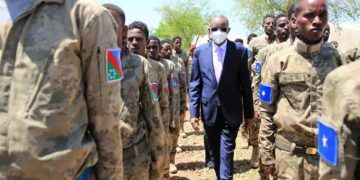
MOGADISHU, SOMALIA – Somalia’s federal government intends to announce that it is taking national security duties back from AUSSOM, and the calendar explains the announcement better than any policy document could. Officials describe the initiative as a transfer of responsibilities to Somali forces, according to sources familiar with the discussions. President Hassan Sheikh Mohamud has spent recent days with army commanders, working through the takeover of bases the African Union still garrisons. None of that sequence began in Mogadishu, however. It began in Addis Ababa, where donors have made clear that the money is running out, and a government losing its subsidy is presenting the loss as sovereignty.

An AUSSOM Handover Timed to Someone Else’s Calendar
The African Union Commission set the timetable that Villa Somalia is now racing. In a letter dated July 20 and marked urgent, it asked Somalia to nominate delegates for consultations on the mission’s future. Technical talks ran in Addis Ababa from July 22 to 24. Senior consultations follow in Kampala from July 29 to 31, and an extraordinary summit of troop and police contributing countries closes the process with a communique.
Read the agenda and the direction becomes obvious. The meetings will examine the operational structure of AUSSOM, its financial framework, force generation and transition arrangements. Military experts have been weighing whether the mission should continue in its present form, whether troop numbers should fall, or whether contributors should start planning a phased withdrawal. Those are exit questions wearing the clothes of a review.
Villa Somalia is not driving any of this. It was invited, and the Commission offered to cover its delegates’ costs, which is its own small comment on the balance of power. Western representatives have meanwhile warned the African Union and the European Union that their money may stop, and have raised the prospect of a veto at the Security Council. Announcing a handover in that setting is an attempt to look like the author of a decision taken elsewhere. Somalia will still arrive in Kampala asking partners to keep funding the mission it says it is ready to replace.
The word urgent in a diplomatic letter carries a specific meaning, and here it signals that the Commission has stopped waiting for Somali readiness to arrive on its own schedule. Delegates were given days rather than weeks to assemble, the agenda was fixed before Mogadishu saw it, and the summit will issue its communique whether or not the Somali roadmap convinces anyone in the room. A government that wanted to shape this outcome would have needed to start work on it a year ago, when the funding mechanism collapsed and the warning signs were already unambiguous.
The Money Behind AUSSOM Was Never Actually There
The financing story is short, and it has no happy chapter. Security Council Resolution 2719, adopted in December 2023, was meant to cover three quarters of an African Union mission’s budget from United Nations assessed contributions, with the AU finding the rest. The council failed to approve that arrangement in May 2025, because Washington refused to support it. Every problem since flows from that single refusal.
What replaced the mechanism was a collection of short pledges and good intentions. Stipends for soldiers, police and civilian staff run to roughly 200 million dollars a year. The mission has been carrying a shortfall above 92 million dollars, alongside about 100 million dollars in debt inherited from ATMIS. Troop contributors have effectively been lending the African Union their soldiers’ pay, and waiting to be reimbursed by donors who have not committed.
The logistics sit on an equally thin ledge. Fuel, rations, medical care and accommodation reach AUSSOM through the United Nations Support Office in Somalia, whose budget of about half a billion dollars is shared with the Somali army and the UN transitional mission. Washington will not fund that office beyond December 31 this year. Since no Somali institution can replace a supply chain of that size, the end of UNSOS leaves the offensive dangerously exposed. Federal ministries have struggled this month to keep their own lights on, which puts the promise to garrison and resupply a national network of bases in its proper context.
The African Union has been improvising around the shortfall for two years. It moved 40 million dollars through its Peace Fund during 2025, took modest bilateral pledges from the United Kingdom, China, Japan and South Korea, and asked troop contributors to keep paying their own soldiers in the meantime. None of that produces a predictable budget, and predictability is the whole point of the financing argument. Countries that have carried the cost since 2007 are now being asked to carry it indefinitely, without a mechanism, on behalf of a government that says it no longer needs them.
An Army Asked to Hold Ground It Did Not Take
Consider what the handover involves on the ground. AUSSOM fields roughly 11,146 soldiers and about 680 police, drawn from Djibouti, Egypt, Ethiopia, Kenya and Uganda. They hold forward operating bases across the south and centre, many of them sitting on the supply roads that connect Mogadishu to Baidoa, Beledweyne and Kismayo. Taking those positions over means finding Somali battalions to occupy them, feed them, pay them and rotate them on schedule.
The recent operational record does not support that ambition. Somali forces and their partners killed 16 al-Shabaab fighters in Middle Shabelle and Hiiraan on July 26, destroying vehicles and a facility used by the group’s propaganda arm. Raids of that kind are real, and they are also the cheapest form of pressure to sustain. Holding terrain is the expensive part, and it is where the army has struggled since last year’s Shabelle offensive pushed it out of positions won in 2022 and 2023.
Al-Shabaab reads the same calendar as everyone else. The group survived ATMIS by waiting, and it has every reason to treat a Kampala communique as a schedule rather than a threat. A phased AUSSOM withdrawal would hand it the one resource it has consistently converted into territory, which is time. Somalia intends to present a roadmap for building army capacity at these consultations, and roadmaps have been presented before. The bases in question are still held by foreigners.
The handover also assumes a functioning rotation system, which is where Somali units have historically come apart. Troops left in place for months without pay or relief either desert or negotiate locally with the insurgency, and both outcomes have been documented across Middle Shabelle since 2023. Foreign contingents rotate on fixed cycles and arrive with their own logistics tail. Replacing them means replicating that discipline in an army whose payroll has been an open question in every donor review of the past three years.
A Handover Announced by a Government Fighting Its Own Regions
There is also the question of who exactly is taking over. Puntland and Jubaland walked out of the Mogadishu election talks this month, and Puntland now refers to the federal leadership as term expired. Garowe accused that leadership of military mobilisation in a statement dated July 25, then warned the following day about federal movements around Galkayo after the fighting in Bosaso. Two federal member states covering much of Somalia’s territory sit outside any national security plan.
That gap is not an administrative detail. A transition from AUSSOM assumes a chain of command running from Villa Somalia to forces across the country. Puntland withdrew recognition from the federal government over the constitutional amendments, rejecting Mogadishu’s claims of unity as a deception, and has separately accused the federal government of running a destabilisation campaign against it. Mogadishu rejects both charges without addressing the documents behind them. Jubaland maintains its own quarrel after the federal push into its elections.
Donors have been watching all of this closely. The American case against funding AUSSOM through assessed contributions has always rested on Somali ownership and security sector reform, rather than on money alone. A federal government that cannot agree an electoral process with two of its member states does not read as a partner ready to inherit a national security burden. Nor do forces that have exchanged fire with a state administration in Bosaso. The handover announcement therefore addresses two audiences at once, and only one of them is Somali.
Puntland’s own position complicates the picture further, because it has spent the past eighteen months fighting Islamic State militants in the Bari mountains with its own forces and its own budget. Garowe uses that campaign as evidence that a federal member state can generate real capability when it controls its own command, and it presents Mogadishu’s difficulties as a failure of politics rather than of resources. Whether or not the comparison is fair, it lands well with the partners who now have to decide what comes after AUSSOM.
What Kampala Can Realistically Decide
Expect the summit to produce continuity on a reduced budget rather than a clean rupture. The African Union has no appetite for announcing a collapse, and troop contributors have no appetite for absorbing costs indefinitely. A trimmed AUSSOM, a stated transition timeline and another appeal for predictable financing would let every delegation leave Kampala with something to say. The arithmetic underneath would remain exactly where it is now.
The mandate itself runs to the end of December 2026, which gives the Security Council one more decision point before the money question becomes unavoidable. Between now and then the mission must plan its posture without knowing what it will be paid, and Somali commanders must plan operations without knowing which bases will still be occupied. Planning under that kind of uncertainty tends to produce the most cautious option available, which in practice means fewer joint operations and more static defence.
What fills the gap is already visible, and it is bilateral. Turkiye has extended its military mandate in Somalia until 2028. Egypt, Ethiopia, Uganda and Djibouti maintain their own arrangements with Mogadishu alongside the AU framework, and Washington has reasons of its own to stay engaged as attacks in the Red Sea corridor increase. The result is a patchwork in which each partner protects its particular interest, and none of them is accountable for Somali security as a whole.
Mohamud will present the moment as the one when Somalia stood on its own feet. Sovereignty announced under financial duress is a thinner thing than sovereignty earned, however, and the difference will be measured in districts rather than in communiques. If AUSSOM contracts before the army can hold what it inherits, the loss will not appear in any summit document. It will appear on the roads out of Mogadishu, in the same towns Somalia has already lost and retaken more than once.