MOGADISHU, SOMALIA – Four years of Somali policy on foreign troops can be read off a single file, and the ATMIS file is unusually candid because every reversal in it was put in writing. Villa Somalia is now preparing a plan to take national security duties back from the African Union. The timing is deliberate, since troop contributors gather in Kampala within days to decide the mission’s future for themselves. Anyone who followed the drawdown will recognise the promise. The government made a version of it in 2022, again in 2023 and most emphatically in 2024. Each time it then asked for the deadline to move, once the date came close enough to hurt.

A Warning From the Man Who Wrote the ATMIS Timetable
The sharpest commentary on that habit arrived this month from the official who once embodied it. Hussein Sheikh-Ali, known across the security sector as Hussein Moalim, spent three years as national security adviser setting withdrawal dates and defending them in public. He now describes the consequences of those dates from the outside. “If African Union forces leave, we can only pray to God. I believe the very survival of the Somali state could depend on their continued presence,” Moalim said on July 16. An army still reliant on foreign logistics, intelligence and air support cannot hold the country alone.
The intervention is worth dwelling on because he made the opposite argument the same day. Somali statehood cannot rest on external forces, he told a separate interviewer. The fault for two decades of dependence lies with successive governments that never built the institutions capable of replacing them. Neither claim is dishonest when taken on its own terms. Both would sit comfortably with someone who had spent the decade watching from the sidelines rather than signing the letters. Held together, however, they capture the ambiguity that has let Somali security policy promise self-reliance at home while pleading for extensions in Addis Ababa and New York.
The contrast with his own tenure runs deeper than emphasis. While serving President Hassan Sheikh Mohamud, Moalim told a VOA Somali audience that al-Shabaab was close to collapse and that no fighters would remain anywhere in the country by July 2024. His listeners, he said at the time, should mark his words. He added that ATMIS would be surplus to requirements once December 2024 arrived. The group survived both dates comfortably, and it has since pushed its checkpoints back towards the capital, including around Hawadley in Middle Shabelle and Basra in Lower Shabelle.
Two Pauses and a Letter That Arrived Five Days Late
The reversals began almost as soon as the mission did. For months in 2022 the government insisted that the timetable be respected to the day. In December it then appealed, at the last minute, for a delay to the withdrawal of the first 2,000 troops. Donors declined to cover the cost of keeping those soldiers in place beyond their funded mandate, and the African Union absorbed roughly 20 million dollars in debt. That episode set the shape of everything after it. A deadline agreed in Mogadishu could be reopened by Mogadishu, at the moment when reopening it caused everyone else maximum disruption.
September 2023 produced the sequence that still defines the file, and the order of events matters. On September 14 the AU Peace and Security Council resolved to withdraw a further 3,000 troops without conditions. The Somali negotiating team accepted that decision and then went beyond it, asking that 851 ATMIS police officers leave as well, although their drawdown had never been on the agenda. Five days later the Office of the President wrote to the UN Security Council requesting a three month delay. That eleventh-hour plea reached the African Union through New York rather than through its host.
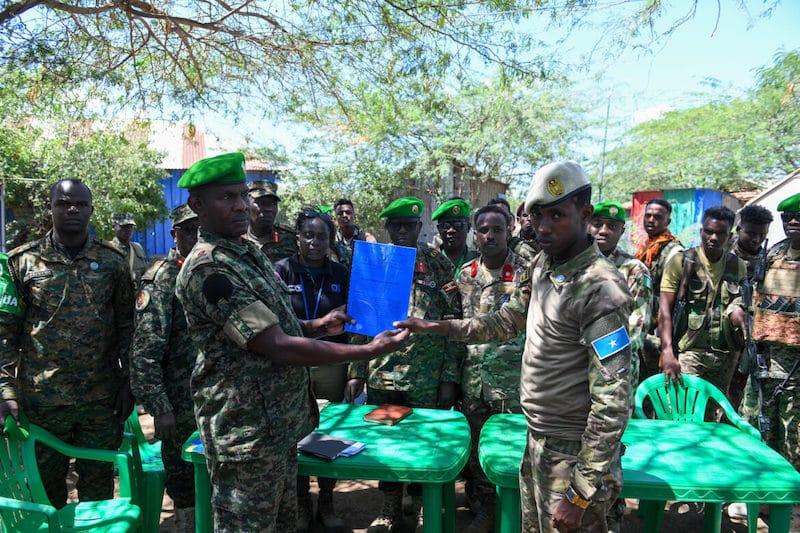
The pause was granted, as such requests generally were, and the deadline slipped again. Phase two eventually concluded in February 2024, a month past its own revised deadline, with seven forward operating bases transferred to Somali forces and two closed outright. Every extension rested on one argument: those forces were not yet ready to hold what they were being handed. It is precisely the argument the same government now dismisses when donors put it forward. The extensions also cost the African Union money it did not have and credibility it could not replace. That institutional memory explains much of the coolness Somali delegations have met in Addis Ababa since.
From an Ethiopian Exit to an 8,000-Troop Surge
By the middle of 2024 the position had swung back towards sovereignty, and it did so in the most public venue available. Speaking on Twitter Spaces on May 31, Moalim announced that every Ethiopian soldier would leave Somali territory when ATMIS concluded on December 31. The claim was disconnected from conditions on the ground. Ethiopia held more than 4,000 troops inside the mission, and thousands more under bilateral arrangements covering Hiiraan, Bay, Bakool and Gedo. Southwest State politicians rejected the plan within days, since nobody had explained which Somali units would replace the Ethiopians in Bay and Bakool. The contingents stayed where they were, and the announcement quietly expired.
The largest reversal in the whole sequence followed a few months later. In April 2025, al-Shabaab overran Adan Yabaal and briefly seized the Wargaadhi base. Within weeks Mogadishu and the African Union agreed to add 8,000 troops to the successor mission, abandoning a drawdown that had run since 2022. A government that had spent three years treating foreign soldiers as an affront to sovereignty now wanted thousands more of them. It wanted them quickly, in regions it had recently called secure enough to hand over.
Nothing close to those numbers materialised, for the unglamorous reason that no donor volunteered to pay for them. That failure is the hinge on which the current moment turns. Read across the whole ATMIS period, the stated Somali position tracked the news cycle rather than the army’s actual capacity. That was true from the first handover ceremony to the last ATMIS flag lowered in December 2024. Sovereignty was the theme whenever operations went well, and the timetable became sacred. Readiness was the theme whenever a base fell, and the timetable became negotiable. Two audiences were served at once, one domestic and one foreign, and neither heard the same thing for more than a season.
The Same Promise, Now Presented as Sovereignty
This month’s handover plan belongs unmistakably to that lineage, and its origins are external rather than Somali. President Hassan Sheikh Mohamud has spent recent days with army commanders discussing the takeover of bases the African Union still garrisons, according to sources familiar with the discussions. The meeting that prompted those talks, however, took place in Addis Ababa. There the AU Commission summoned Somalia to consultations on whether the mission should shrink, restructure or plan its exit. A government invited to a meeting about its own future rarely leaves holding the initiative, and announcing a handover in advance is one of the few ways of appearing to.
The timing is explained by money rather than by any new confidence in the army. Washington will stop funding the United Nations Support Office in Somalia after December 31. That office supplies the fuel, rations, medical care and airlift on which the mission and much of the Somali army depend. The end of UNSOS leaves the south dangerously exposed. Faced with that cliff a government has two available postures, and only one of them survives contact with a domestic audience. It can concede that it cannot fund the war, or it can declare the help unnecessary, which is the line Villa Somalia took in 2024 and has taken again now.
The political ground beneath the promise is weaker than it was during the ATMIS years. Puntland and Jubaland have walked out of the electoral talks, Puntland calls the federal leadership term expired, and federal and Puntland forces exchanged fire in Bosaso this month. Al-Shabaab’s offensive feeds on Mogadishu’s political chaos. A national handover designed by a government that controls neither administration covers part of the country, and is presented to donors as though it covered all of it. The ATMIS transition at least carried a nominal federal consensus among the member states, and this one carries nothing of the kind.
What the ATMIS Record Predicts
A documented pattern supports a forecast, and this one points in an obvious direction. Expect the handover to hold until the first significant base is lost. At that point the government will seek a technical pause, write to New York, or quietly ask Turkiye, Egypt or Uganda for bilateral troops to fill the gap the departing mission leaves. That is not a cynical reading of Somali intentions. It is the documented sequence of December 2022, September 2023 and April 2025, repeated so closely that the African Union now budgets for the request rather than the promise.
Moalim’s warning carries weight precisely because he helped build the record he is describing. His framing of the problem as a failure of successive governments, rather than of any individual adviser, is both self-serving and largely correct. The pattern outlasted him, as it outlasted the ministers and commanders before him. What nobody in Villa Somalia has been made to explain is why the assessment changes so completely between the moment a deadline is agreed and the moment it arrives. No explanation has been offered this month either, beyond the losses that anyone following the Shabelle valley can see.
The cost of these swings falls on everyone obliged to plan around them. Troop contributors budget for a mission whose host redefines what it wants at roughly six month intervals. Donors are asked to fund a readiness that is declared complete whenever the funding looks fragile. Commanders in the forward bases discover which version of the policy applies to them only when the resupply arrives or fails to. Al-Shabaab needs no consistency of position and answers to no donor conference. It has spent the same four years converting each pause and each reversal into the ground it now holds within sight of the capital.