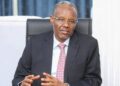


KISMAYO, SOMALIA – General Mahad Abdirahman Aden, the former commander of Somalia’s Custodial Corps, has placed the removed South West administration inside Jubaland and thanked its president for sheltering it. Speaking to a Somali television channel on Sunday 20 September, he said relations between his camp and Jubaland’s senior leadership are good, that the Darawish loyal to former President Abdiaziz Laftagareen are present in areas of that administration and particularly in Gedo, and that President Ahmed Madobe and the people of Jubaland had given him more support than anyone after the attack on his house at Doolow. He then said the Darawish are positioned around Baidoa and intend to return to the city. Neither Kismayo nor Villa Somalia has responded to any part of it.

The Thanks the Darawish Paid to Kismayo
Demonstrations over the Doolow strike were the measure Taliye Shub used, and he counted them by administration. They took place across Jubaland and did not take place in Galmudug, he said, and there was not one district of Jubaland that failed to turn out. The first of them reached Doolow, where the missiles landed, and the last was at Afmadow, four hundred kilometres to the south. He named President Ahmed Madobe personally and thanked the Jubaland government for what he called everything it had done for him.
Public thanks of that kind are a political act in Somalia and both parties know it. A federal member state that permits demonstrations in every district over an attack on a man Mogadishu has declared an outlaw is making a statement about where it stands, and a man in his position naming the president who allowed it is converting sympathy into an alliance on the record. The interview was given in Kismayo, which is the second half of the same message. He spoke from the Jubaland capital, on a channel watched across the south, without asking anyone in Kismayo to disown the remarks afterwards.
The account he gave of the Doolow attack itself has not changed since he first set it out. He described a Turkish F-16 over his roof at midnight, two missiles into the room where he slept, and a driver now in custody, and he named three senior officials he holds responsible without producing evidence for any of it. Former President Abdiaziz Laftagareen made a narrower allegation in the days after the strike, naming two Turkish nationals and one Somali, and nothing has come of it in three weeks. Ankara has neither acknowledged nor denied any role, and the fact-finding committee the federal government promised has published no findings eighteen days after the explosions.
Why the Darawish Are in Gedo
Gedo is the one region of Jubaland where the federal government and the state administration have contested every garrison for six years, and it is now hosting the armed remnant of a third administration. Doolow sits on the Ethiopian border at the northern end of it, beyond the reach of the federal army and inside the writ President Ahmed Madobe claims. Abdirashid Janan walked his federally recruited Gedo forces back to Jubaland in August, and Kismayo assumed their salaries. The Darawish have now arrived in a region that has just absorbed one defection from Mogadishu.
Jubaland’s quarrel with Villa Somalia predates the South West crisis by two years and has followed the same arc. Federal troops were deployed against President Ahmed Madobe after the Jubaland election, the deployments failed at Ras Kamboni, and Kismayo has since run its own security relationships, including with American special operations officers who met the Jubaland leadership in Nairobi. Jubaland and Puntland have jointly asked the Security Council to revisit the arms embargo lifted in December 2023, citing the Doolow strike among their reasons. Two federal member states that spent the past two years resisting Villa Somalia separately are now making the same request in the same forum.
Sheltering the Darawish costs Kismayo little in the short term and buys it a second front for Mogadishu to worry about. It also carries a risk Kismayo has not discussed in public, because the federal government has already classified these men in a category that removes the protections of a political dispute. A state that hosts them is hosting people the defence ministry counts among its declared enemies, and the legal position of everyone in Gedo shifts accordingly. Doolow has already been struck once by an aircraft nobody will claim, which is the practical form that shift takes.
The Darawish Put Their Objective at Baidoa
The claim about Baidoa was the one operational statement in the interview. He said the war would continue, vowed that they would return to the capital of Bay region, and stated that their forces are at present around the city and will press the operation until the other side is driven out. No timetable was given and no troop numbers were offered, and the claim has not been corroborated by anyone inside Baidoa. No fighting in the city was reported over the weekend by any outlet, and the administration there has said nothing about forces on its perimeter.
Fighting has run in and around that city since March, when President Hassan Sheikh Mohamud’s government removed former President Abdiaziz Laftagareen, suspended the flights and installed President Aden Mohamed Nur Madobe in June through a managed vote. Pre-dawn assaults on army positions inside Baidoa in August left about thirty dead by the defence ministry’s count. Mogadishu sent its army into the Bay region against the president it had removed, and the campaign has not ended. Flights between Mogadishu and Baidoa were suspended in mid-March and the removal followed on 30 March, with two dead and twenty-five wounded on the day.
Former President Abdiaziz Laftagareen’s camp has meanwhile continued to behave like a government in waiting. A cabinet of fifteen ministers and deputies was issued in former President Abdiaziz Laftagareen’s name on 18 September, with portfolios for internal security, education, agriculture and public works, while President Aden Mohamed Nur Madobe’s administration holds the ministries, the assembly and the presidential compound in Baidoa. Two cabinets now exist for one state, one of them in the city and one of them in the field with the Darawish. No decree carrying a signature or a seal accompanied the second list, and the administrative machinery behind the appointments has not been published.
The Category Mogadishu Has Put Them In
President Aden Mohamed Nur Madobe’s administration in Baidoa has already answered the question of what it calls these men. South West State warned civilians in September to leave areas held by the Darawish or by al-Shabaab and announced airstrikes, putting both in a single sentence. The defence ministry filed the roughly thirty dead from the August fighting as Khawarij mixed with Laftagareen militias, and former Baidoa officials who examined the same images identified them as Darawish. Mogadishu has also frozen bank accounts and withdrawn passports from figures in the removed administration, which is the administrative half of the same policy.
That classification is what makes the Jubaland arrangement consequential beyond South West. Mogadishu’s argument for the past six months has been that its domestic armed opponents belong in the same file as the insurgency, and the argument has travelled with the men. A federal member state that gives them ground and permits demonstrations for their commander is, on the federal government’s own reading, sheltering something other than an opposition. The African Union memorandum of 21 August authorises its mission against al-Shabaab affiliates while ordering it out of political fighting, and the two categories meet in Gedo.
Nothing in the interview was confirmed by the Jubaland presidency, which has issued no statement on hosting the Darawish and no comment on the Baidoa claim. President Ahmed Madobe has spent two years declining to accept federal terms in his own state and has not said what terms he places on this. The clearest account of where the removed South West administration now sits came from its own commander, in Kismayo, on a television channel, with the government it fled from saying nothing at all. Everything known about where the Darawish are camped, and what they intend to do from there, rests on the word of the man who told it.