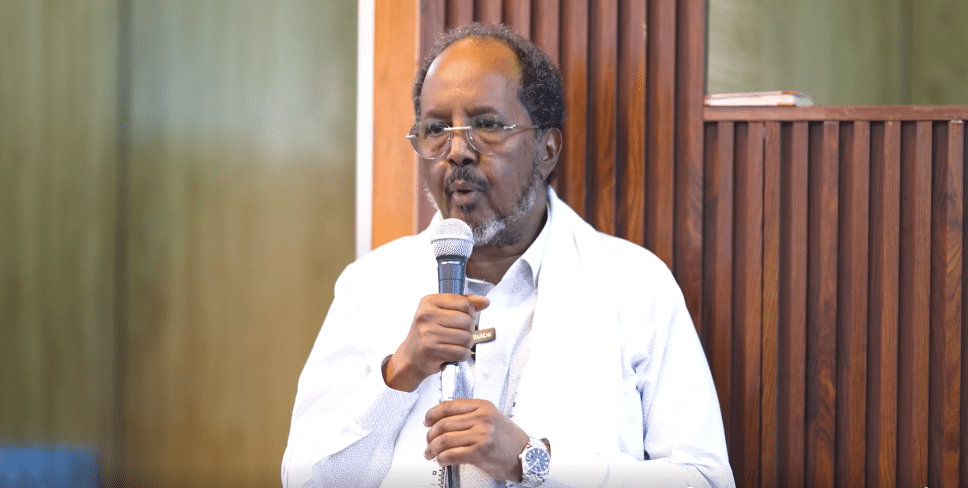
MOGADISHU, SOMALIA – The head of AFRICOM flew into Halane on Thursday to talk about al-Shabaab. He left having talked about Villa Somalia instead. General Dagvin R.M. Anderson met President Hassan Sheikh Mohamud alongside senior American diplomats. The public read-out stayed on safe ground. Sources briefed on the closed session described a much blunter exchange. Washington wants a political deal first, and it says the war cannot be won without one.

That is a sharp turn for a partnership built on drones, trainers and money. For four years the American link to Mogadishu has run through the security file. Now the security file has become the lever. The visit landed in the same week that regional leaders met in Kampala to argue over who pays for the African Union mission. The timing was not an accident.
What the AFRICOM commander actually raised
The presidency framed the meeting around counterterrorism, army reform and defence ties. Sources familiar with the talks say the American side went further. They pressed for a deal among Somali stakeholders. They argued that consensus is what makes security gains stick. Washington is also reviewing how it backs Somalia, and future support will follow results rather than promises.
Three complaints stood out, and none of them concerned al-Shabaab. American officials objected to the use of security forces in political disputes. They objected to federal meddling in the affairs of member states. They objected to how weapons are handed out. Each point describes something the federal government is accused of doing. Each has been raised for months by Puntland and Jubaland. Hearing them from the AFRICOM commander changes their weight.
Villa Somalia has not answered the reported criticism in public. Its silence is telling on its own. When Mogadishu likes a foreign message, it shares that message within hours.
Washington shifts from funding to conditions
The AFRICOM message did not arrive out of nowhere. Days earlier, diplomatic sources said the United States and Britain were preparing a final push to seat Hassan Sheikh with his rivals. That table would include the leaders of Puntland and Jubaland, plus figures from the Somali Future Forum. Hopes for the effort are low, and the diplomats say so themselves. Yet one Western government has floated something harder. If Somali leaders cannot agree, the state-building framework itself could be reopened.
Reopening that framework means revisiting two decades of work and billions of dollars. It could also mean a return to a transitional-style setup. Backers of that idea argue that the federal mandate expired in May. They argue that the president extended his own term without consensus. They add that charter changes were pushed through without broad support. Mogadishu rejects the framing and says the process remains lawful. The argument is now being had in Western capitals rather than Somali ones, which itself measures how far the deadlock has travelled.
AFRICOM does not run that political track. Still, a commander who repeats the same terms in a closed room settles one question. The military and diplomatic sides of Washington are aligned.
The Jubba Corridor argument Villa Somalia lost
One operational split surfaced clearly. American officials backed the Jubba Corridor campaign against al-Shabaab in Middle Jubba. The group has held that ground with little interruption. Hassan Sheikh reportedly rejected any operation launched from Jubaland that involves the forces of neighbouring countries. He told the delegation such a plan would not be acceptable to his government.
Read plainly, a president turned down an offensive against al-Shabaab because of where it would start and who would join it. Kismayo has spent two years outside Villa Somalia’s control. Ahmed Madobe remains among the president’s fiercest rivals. An operation staged from Jubaland would hand Madobe standing, foreign partners and supply lines. Mogadishu would rather leave Middle Jubba alone than accept that outcome.
The same logic explains why Somali forces fight hardest where politics rewards them. Al-Shabaab reads the pattern too. The group has spent 2026 retaking towns in Hiiraan and Middle Shabelle. Federal attention drifted toward election disputes and toward the north.
Puntland sits at the centre of the AFRICOM complaint
American concern over federal meddling points in one obvious direction. Tensions between Mogadishu and Garowe have run hot since Puntland stopped recognising federal authority. They grew sharper as federal-aligned militias appeared near Bosaso and in the Mudug corridor. Puntland has accused the federal government of moving weapons into its land to provoke a civil war. Mogadishu has never formally answered that charge.
Arms distribution was the third item the AFRICOM delegation raised. That is not a coincidence. Washington tracks Somali weapons stocks closely, and diversion has embarrassed American programmes before. Puntland has also cast itself as the state that fights ISIS and al-Shabaab without federal help. That record makes it a useful partner for donors losing patience with Mogadishu.
Jubaland holds a similar position. Both states argue that Hassan Sheikh has bent the national army toward domestic rivals. The charge echoes his constitutional manoeuvres of the past two years. American officials appear to have adopted at least part of that reading.
Why AFRICOM cannot fix a political problem
The money question sharpens everything. Washington will stop paying for United Nations logistics support to the African Union mission after December 2026. The Kampala summit met because nobody has replaced that cash. Troop contributors want thousands more soldiers on the ground while the budget shrinks. Donors are less willing to bankroll a mission propping up a government they consider stuck.
That is the trap. Somali forces cannot hold ground alone. Foreign forces are being priced out. The political deal that might justify more spending keeps slipping away. AFRICOM can supply airstrikes, advisers and intelligence. It cannot supply an agreement between Hassan Sheikh, Deni and Madobe. Anderson’s visit made that limit plain rather than implied.
Opposition leaders reached the same conclusion this week. They wrote to troop-contributing countries urging a political deal before any security handover. Their argument and Washington’s now sound remarkably alike. The president’s electoral credibility has been questioned since 2022, and that convergence is the real danger to him. AFRICOM came to discuss al-Shabaab. It left having described a government its own partners no longer trust to hold the country together.